Stories on Whalls: Church of the Holy Cross, Sarratt

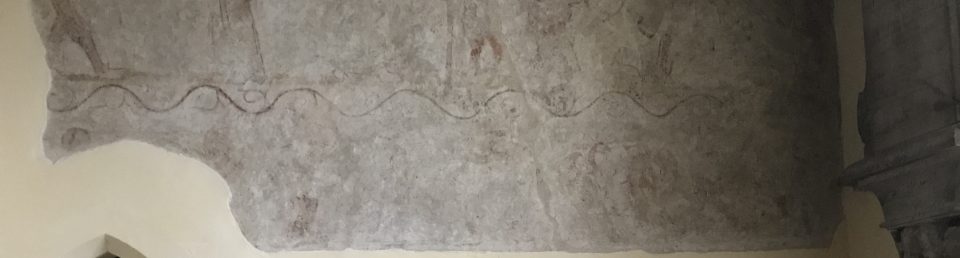
Whall was responsible for the “Charity” window in this church. It is the East window in the North Transept. The window dates from 1923. The Church dates back to circa 1190. Whall was responsible for two other windows, “St Cecilia” and “Bringing the children to Christ”. The “Charity” window comprises two lights featuring angels. There is a panel below each light and in the panel below the left hand light is a heart and below the words “Deus Caritas Est”. “Bringing the Children to Christ” is the earliest of the three windows and was installed in the West of the tower in 1913. It is a two-light window and in the left hand light we see a mother with two children. They look towards the right hand light in which we see Jesus with a third child. In a roundel above the two main lights, two angels are shown and the inscription “In Heaven their angels do always behold the face of the Father.” The window “St Cecilia” was installed in 1921 and is the South window, South Aisle. St Cecilia sits at a piano. The window was commissioned in her memory by the children of Emily Catherine Hamilton Ryley. (List of works by Christopher Whall)

And then, there’s the M25, always present, always humming, always flowing. Or trying to. 50 years it wasn’t. It might have a glimmer in a planner’s eye but when we were growing up in the area, the challenge that the M25 was to become and the traffic it would generate was beyond our imaginations.

We were able to ride our bikes through the narrow country lanes out of Heronsgate, around Chorleywood, down Solesbridge Lane and up to Sarratt without having to dodge lumbering articulated HGVs which had taken the wrong SatNav instruction and now found themselves squeezing through bushes and demolishing rabbit warrens before they were forced to reverse perilously, jack-knife and bring the whole of South East to a gridlocked halt. It’s amazing how one errant truck can take a wrong turning and seize up the nation’s supply chain.

In those days, Holy Cross Church in Sarratt would have looked very much like it does today – and probably how it looked like 800 years ago. Motorways may wax and wane but these older churches are made of hardier infrastructural policies.

But these days, the M25 helps you makes a trip to Sarratt by car in a hop skip and a jump and within minutes you can find the village’ s now empty duck pond, the Village Hall (scene of my first young farmers disco) and the Cricketers Arms (home of beautiful cobalt blue cutlery which is unfortunately not for sale).

A ten minute walk down Church Road – greeted politely by locals (“lost your way? You’re not from ‘ere are you?”) making it clear there’s nothing more suspicious than a couple of blokes walking down a country lane – leads unsurprisingly to the church, in which Christopher Whall is present, jostling for attention with the likes of Powell and Alfred Fisher. In the Baptistry, there’s St. Cecilia, patron saint of musicians, dating from 1921; in the Bell Tower, Bringing the Children to Christ (1913) and in the North Transept, Charity (1923).

Back outside, you clock that the Church of the Holy Cross  is opposite another pub, The Cock Inn, with its promise of ‘fab fish weekends’, which no doubt complement the fish and loaves Sunday mission of Holy Cross itself. The pub and the church: constants in an ever changing flux of articulated lorries, traffic diversions and speed cameras.

What comes first, the window or the wall?

The PTA of my old school recently invited me to see a ‘Wall of Honour’ they had installed on the main school corridor which, over the years, must have witnessed millions of pupil, parent and teacher journeys all in the search for the holy grail of a perfect education.

Part of the lead up to the installation was a request by the PTA to send in photos of what its alumni had done since they had stopped patrolling that corridor in search of the perfect girl or boy friend and left the school for good.

I duly obliged with a few photos of my own and as I approached the school became increasingly intrigued with what they had done with the photos on the corridor walls.

How would they frame this ‘wall of honour’? How would they stop errant 4th formers from making they own marks on the august faces beaming at them from the privilege of their post-school hide-aways? Would the ‘wall of honour’ be accompanied at some point by a floor of concrete which everyone would be invited to put their own footsteps into, making the corridor full of indelible marks on both its walls and floor?

All that would be needed to complete the effect would be a ceiling of the most anointed: those alumni who had developed stellar careers – or serious drug habits – which would mean they could only be found by being dragging them off a different ceiling or out of the heavens.

So as I was escorted down to the corridor of a million journeys, it’s fair to say that calling the experience underwhelming would be an understatement. It’s six pictures in frames underneath the PTA title board: the complete antithesis of what telling a good story on a wall might look like: something the Whalls were both pretty good at.

It’s amazing how we think that just sticking something on a bare wall is better than nothing. Actually, it’s worse than nothing as at least a bare wall has some sense of purity to it. Desecrating it with some half-thought out plan demeans both the plan and the wall. Better to do nothing than just gesture, aimlessly.

Trouble is, a wall invites you to make a mark. Challenges you to add Something where nothing’s actually needed. It says, go on then, if you think you’re so important, beat this. Make your mark count more than my empty space. And more often than not we get it wrong, especially in public spaces where getting the marks right is even more important, given you’re speaking to far more many people than you would do than if you were in the privacy of your own living room.

The Whalls though weren’t simply about stories on walls – but in windows which were part of the wall; or a different type of wall with a different purpose. You wonder, does the brick work support the glass? Or does the glass determine what kind of brick work is needed? What comes first, the window or the wall?

Whatever the answer, the PTA of the old alma mater could do with some serious rethinking of what the purpose of the walls, floor and ceiling of a school corridor is all about.

Crazy old Trot! (with thanks to Monty Python)

Jeremy: I wanted to be… a Crazy Old Trot!

Leaping from sect to sect, as they float through the mighty rivers of the British Labour Party… The Giant International Socialist. The SDP. The Far Right! The mighty SNP! The lofty flowering Communists! The plucky little SWP! The limping soft Tory of Aldershot! The Maidenhead Weeping Wets! The flatulent Blairite of Sedgefield! The Quercus Maximus Millibandus Edwardus!

With my best buddy by my side, we’d sing! Sing! Sing!

[singing]
I’m a Crazy Trot, and I’m okay.
I sleep all night and I plot all day.

BLAIRITES:
He’s a Crazy Trot, and he’s okay.
He sleeps all night and he plots all day.

JEREMY:
I cut down Tories. I eat my lunch.
I go to the lavatory.
On Wednesdays I go shoppin’
And have buttered scones for tea.

BLAIRITES:
He cuts down Tories. He eats his lunch.
He goes to the lavatory.
On Wednesdays he goes shopping
And has buttered scones for tea.
He’s a crazy Trot, and he’s okay.
He sleeps all night and he plots all day.

JEREMY:
I cut down Tories. I skip and jump.
I like to press wild flowers.
I put on women’s clothing
And hang around in bars.

BLAIRITES:
He cuts down Tories. He skips and jumps.
He likes to press wild flowers.
He puts on women’s clothing
And hangs around in bars?!
He’s a lumberjack, and he’s okay.
He sleeps all night and he plots all day.

JEREMY:
I cut down Tories. I wear high heels,
Suspendies, and a bra.
I wish I’d been a girlie,
Just like my dear Papa.

MOUNTIES:
He cuts down trees. He wears high heels,
Suspendies, and a bra
He wishes he’d been a girlie
Just like his dear papa.

[singing]
He’s a crazy old Trot, and he’s okay.
He sleeps all night and he plots all day.
He’s a Crazy Old Trot, and he’s okaaaaay.
He sleeps all night and he plots all day.

Poetry on the Hoof: It Ain’t Over ’till It’s Over.

It ain’t over till it’s over,
It ain’t done till it’s done,
The fat lady ain’t singing yet,
She’s sat inside her tent.

It ain’t over till it’s over
It ain’t done till it’s done,
The carnival ain’t started,
The clown’s not yet farted.

It ain’t over till it’s over,
It ain’t done till it’s done,
This corpse ain’t stopped twitching yet,
Put the funeral back on hold!

So save your tears, save your whoops,
Stop living in the future,
Stop living in the past,
It’s the here and now that matters
And tomorrow’s a world away.
There’s nothing to take for granted,
Nothing to assume,
You can plan and scheme all you like
But.

It ain’t over till it’s over,
It ain’t done till it’s done,
The fat lady ain’t singing yet:
She’s still sat inside her tent.

Measuring the arts. Again. And again. And again….

Many of us in the arts and creative industries have gotten used to measuring our work and talking about it in terms of value, value added, gross value added and all those signals which try to suggest that we’re doing more for the world than simply making great art.

We keep a keen eye on our financial outputs through annual accounts, box office returns, projections and bottom lines as if we’re talking about the arts as a golden goose which is going to keep laying us lots of lovely Faberge nest eggs for our future retirement; we use a whole systems of Heath Robinson-esque paraphernalia to measure personal growth, family change and social wellbeing if we’re using the arts instrumentally to affect people’s health, mindfulness and general absence of psychotic tendencies; and we’re in thrall to audience engagement tools which help us understand who came to an event, why they came, which bit of Beethoven’s 5th they most enjoyed, which bit they least enjoyed and whether they’re more likely to return if we just play them the best bits over and over and over again.

This fetish for measurement never stops and there’s always someone somewhere who wants to measure it again. And again. And again. In different ways, with different criteria, with different emphases and with different toolboxes. All in their own way to prove, beyond incontrovertible doubt that there is more to great art than just great art. That is has other benefits which are more measurable and definable, and that if we could only understand what they were, the arts world – our world, your world – everyone’s world would be a damn sight happier place.

The trouble is, this desire to measure everything within an inch of its life is having precious little effect on the political movers and shakers and critical opinion makers who will listen to what they want to listen to, irrespective of the evidence of all that measurement.

For example, the case for the economic importance of the arts has been made ad nauseum since the 1980s and yet it seems to have little influence on the key politicians and decision makers of anyone’s generation. Every 6 months or so it seems there’s another arts funding crisis which uses the same rhetoric as 5, 10 and 20 years ago. For all the measurement that’s been going on, and for all the cases that have been made that the arts are good for the nation’s bank balance, its mental health and its artistic sophistication, there’s been remarkably little effect on the politicians who instruct the bean counters to change their thinking to any great degree. The only study that seems to be missing is the one which measures the effect that measuring the arts has on the measurers.

Perhaps one day we’ll recognise the futility of the measurement paradigm and accept that great art is just that – great in its own right, impossible to quantify, pin down and stick in a butterfly cabinet.

броненосец-потемкин: Творческий потенциал проекта

Об организации «Aspire trust»

«Aspire trust» – это организация, которая находится в Ливерпуле (Великобритания) и осуществляет свою деятельность в области культуры. Она была учреждена в 2002 году. С этого времени «Aspire trust» развивается, объединяя работу в таких сферах как культура и образование, реализует проекты в Великоритании и во всем мире.

Основные направления деятельности компании включают:
* создание и поддержку небольших компаний, работающих в творческих областях деятельности

* образовательные проекты для учащихся школ и университетов в таких сферах, как креативное преподавание, обучение и педагогика;

* программы по внедрению креативных методов обучения для учителей и работников творческих профессий;

* культурные проекты и организация мероприятий в сферах искусства и образования;

* научно-исследовательскую деятельность в области образования и общественных наук.

Подробную информацию о новых программах Вы сможете получить на сайте: http://www.aspire-trust.org.

«Сокровищница» – наша недавняя совместная театральная постановка, которая была представлена зрителям в октябре 2012 года. Представление проходило в здании Англиканского Собора Ливерпуля, и его смогли увидеть порядка 3600 зрителей. С более детальной информацией Вы можете ознакомиться на сайте: http://www.atreasuredevent.com/

Планируется, что следующим нашим проектом станет «Броненосец Потемкин»: ошеломляющая мультимедийная опера по мотивам легендарного фильма Сергея Ейзенштейна.

Ради этой постановки мы создаем уникальную творческую команду, в которую войдут: Патрик Динеен – режиссер/композитор, работающий в Ливерпуле, Кевин Гудли – один из всемирно известных создателей музыкальных видеоклипов, “Muf” – лондонское сообщество архитекторов, занимающееся городской архитектурой / художники и работники культуры, участвующие в Глобальном проекте по созданию виртуальных театральных постановок (Global Virtual Theatre Project).

Кроме того, мы хотим привлечь творческие кадры из России для участия в основных действиях постановки, а именно:

* Руководителя хора из России, который сможет приобщить исполнителей (среди которых будут как профессионалы, так и любители) к музыкальным традициям и особенностям славянской музыки и пения

* Либреттиста из России, который заинтересуется возможностью написания либретто для проекта (на русском и/или английском языках)

* Дизайнера из России, заинтересованного в создании костюмов, декораций и элементов освещения для проекта.

За более детальной информацией просьба обращаться к:

Доктору Нику Овену Кавалеру Ордена Британской Империи
Директору ООО «Aspire Trust», Великобритания
Valkyrie Lodge
30 Valkyrie Road
Wallasey CH45 4RJ

Тел. 0151 639 9231
Моб. 077422 71570
Email nowen.aspire@btconnect.com
Skype name richardnyowen

Сайт http://www.aspire-trust.org

Give us This Day: a Toast to Resistance

No No No No No No No.

No No No No No No No.

No No No No No No No.

No No No No No No No.
No No No No No No O..

K, go on then.

My Lords, Ladies, Gentlemen and Members of the Jury, please raise a toast to Resistance.

Give Us This Day Our Daily Toast: read all about toasting here


Participants wanted for “Street Art” project, 23 – 30 September in Luxembourg

Inter-actions are organising a Youth Democracy project called “Street art” which will give an opportunity to more than 80 young people from 4 countries to have a participative reflection about the place they have in the society through urban cultural active participation.

The themes will revolve around the role of active participation, empowerment, education, values. Street art forms are different around Europe and may change, but the street art stream goes on and is part and parcel of our all day life and urban space. Politics at any level cannot disregard this aspect that is part of our souranding and with this project we want to bring it to the open discussions.

In “Street art” young people will be able to participate in a complex self-development programme that will provide them with the necessary skills, knowledge and experience to become active social actors and get reflection about the topic. If they will come from the artistic backgrounds- the project will make them aware of civic dimension of their work, influence of their work on urban space and other citizens. It will also make them aware how their creation can be constructive for others and for their future employment. For all participants the project will be a chance to come into the dialogue with politicians on local level- the action that was not in their agenda till now. The project will reveal the sense of the common debate on topics that are important both for youth and for local authorities.

Active young people will take part in one of the 2 international Urban Seminars that will be organized in Luxembourg and in a “Open Art Week” that will organise street art events in several places in the country. It will give them a chance to reflect about street art and exchange their experience and opinions. These 3 events will provide young people with concrete methodology that they will be able to use after the international activity in their home countries with other peers.

Each Urban Seminar will have a particular focus. The first one will be around urban music (dance, singing, beatboxing), the second about visual art (graffiti, light animations, etc). The third event will bring together 40 young people who will organise events around Luxembourg.

During the 3 events young people will debate with decisions-makers, MEPs, deputies, mayors and experts about related topic as well as interact with local groups. The seminars will be organized in cooperation with local authorities and give visibility and content to the event. The discussions during the seminars will be facilitated by young people themselves to give them a chance to experience leading a real participative activity.

The project will have a sustainable impact and multiplier effect. We believe that many young people will be empowered by this action.

The project will reach numerous young people as well as decision-makers and make streetart as support for youth positive active participation.

Contact:

Luc Wendling
16,rue fort Wallis
L-2417 Luxembourg
Mail: wendling@inter-actions.lu
Tel.00352 492660
Gsm:00352 621 227 285

PASCO: animating communities through the creative industries (the Aspire role)

The PASCO (Performing Arts Scene in Obrenovac) project has had significant effects on the cultural infrastructure in the Obrenovac municipality since the project started in 2009. Due to generous support both locally, Buskerud County in Norway and the KS funding programme of the Norwegian government, PASCO has had demonstrable economic, cultural and social impact on the region. The Aspire Trust, together with its Serbian and Norwegian partners had a critical role to play and this post discusses how that role was played out and what specific approaches were taken to achieve that success.

The Aspire Trust: a brief introduction

Aspire is dedicated to touching lives through creativity. Whether 3 or 93 years old, we offer a range of stimulating, innovative and challenging arts based programmes which will help people tell new stories, create new opportunities and learn new skills.

We were founded in 2002 as an Education Action Zone (EAZ) in the Wirral, UK  to help students in schools in deprived communities increase their educational attainment, attendance in school and attitudes to learning. It was so successful that when the EAZ funding ended in 2004, the Trust continued as an independent social enterprise and registered charity.  From its local beginnings in Wallasey, the Aspire Trust has grown into a truly international enterprise with links in India, the Middle East, Nigeria, and across Europe: most notably in Serbia, the Balkans and South East Europe.

What does  Aspire do?

The methodology informing our core activities is based on community arts based practice: a form which has been proven over many decades, in many different cultural contexts to have significant economic, social and cultural effects on local communities and economies across the world.  Whilst visible in the UK, the USA, Australia and many other countries across the world, it is also frequently prevalent in many parts of the world although its adherents and practitioners would not necessarily name it ‘community arts’ as such.

Its identification is made more difficult as its practice is hard to pin down and determine with any degree of clarity; it is  a concept which many people find hard to understand, sometimes equating it with amateur arts, arts activism or arts therapy.

However, we are quite clear about what we mean by ‘community arts’: it is arts practice which has a social purpose, uses high quality participatory techniques and is presented in a wide range of public spaces.   It uses creative and collaborative arts practice to identify the things that matter to people, to engage them in connecting them to their communities and the wider world and to tell tales that need to be told.

There is necessarily a fundamental connection between professional artists and communities in this process and that connection is characterised by people working together for a common good  – whether this be cultural, social or economic. It is not just about professional practitioners doing something ‘for’ or ‘to’ people; it is not just about teaching and learning new skills and it is not just about developing products and services which reflect particular issues that a community may face – although it may involve all of these things to a lesser or greater degree.

Rather, Community Arts practice emerges from the combination of social purpose, purposeful participation and production and promotion in public spaces: it is not a definable product or service which can easily be packaged up but a phenomenon which arises when a combination of people, places and politics coalesce at a particular point in time, space and history.

It is this methodology and approach we introduced to the PASCO project in 2009 and which we would suggest has been an important element of the success of the programme since then.

How did Aspire contribute to PASCO?

Aspire contributed knowledge and expertise through the following elements of the PASCO project:

Web design (Morning Movers) and Marketing workshops (October 2010)

Advice and Guidance on production of Christmas Show (December 2010)

Production of 2 short films made by PASCO participants (PASCO Film School, December 2010)

Delivery of workshops in performing arts for disabled people (December 2010)

Course design and delivery of the Autumn School, Buskerud (October 2011)

Shadow Theatre and Puppets workshops (May 2012)

Workshop on Partnership and Collaboration (November 2012)

Performing Arts workshops for UK based site specific production, Treasured (May 2012)

Cultural Exchange in Liverpool with students from FYR Macedonia (October 2012)

Furthermore, the results of other elements of the programme can also be viewed online:

Morning Movers short documentary film: http://www.youtube.com/watch?v=ky209K2JdqQ

Visit to Liverpool as part of the Treasured project:

http://www.youtube.com/watch?v=MJWiwDoSilg

Short film: Kuda Ide Ovaj Zivot (Where Is This Life Going?):

http://www.youtube.com/watch?v=PYrTC_zTbVM

Short film: The Book of Life

http://www.youtube.com/watch?v=21HpzRJXtck

Thursday Beatbox short documentary film:

http://www.youtube.com/watch?v=yuajksxYFN4

Short film: Anti-Dream Candy

http://www.youtube.com/watch?v=0WXrKYeDlxk

How did Aspire contribute to the success of  PASCO?

Aspire’s arts based methodology is based on community arts principles: arts practice which has a social purpose, uses high quality participatory techniques and is presented in a wide range of public spaces.  There are several implications of this practice for artists, teachers, practitioners and participants which we aim to address when it comes to participating or leading a project.  These are as follows.

Social purpose

Community arts practice is driven by a social agenda: this may involve attempting to address a number of social ills such as unemployment, social exclusion or cultural intolerance.  Whatever the motive, it is the social agenda that provides the ‘call to action’ for community artists, not the cultural agenda implicit in an ‘arts for arts sake’ model.

Participation

Community Arts practice depends on the ability of its practitioners to engage a wide range of people in a diverse range of settings, spaces and cultural contexts.  Frequently, they may be working with people for whom school and traditional, didactic ways of teaching and learning are not appropriate. Consequently, they need to understand that their strategies of engaging people in the creative process rely heavily on constructivist forms of learning: forms which are experiential, value the voice and experience of the participant and which are about facilitating peoples expressiveness and creativity, as opposed to instructing them.

Presentation

Without the element of presentation in community arts projects,  work becomes too process orientated and means that the audience from whom the work stemmed are unable to comment on or feedback to the artists and participants who were responsible for generating the work in the first place.  This issue is constantly referred to in debates of whether ‘process or product’ is more important in the community arts field:  our view is that both elements are equally important.  Presentation however does not have to happen in traditional platforms of the theatre or gallery; they can also take place in the housing block, the day centre or increasingly on-line via blogs, YouTube, Facebook or other social networking sites.  What is critical in this part of the work is that whatever is produced or published to the wider public has to be of the highest quality: not just its production values but with the necessary frameworks around the work which help contextualise the work to audiences who may not be  familiar with the background to a particular context.

Partnership working

We aim  to build effective partnerships between  artists, educators and participants.  By ‘partnership’ we mean the development of relationships which are based upon principles of co-constructing, co-delivering and co-assessing unique, challenging and innovative creative arts educational projects in which all participants’ voices are heard.   The principles we aim to adhere to behind effective partnership working are available on line at https://www.dropbox.com/s/na92hsteaiu2yef/effectivepships.ppt

Commitment to Professional development

We believe and are committed to delivering practice which extends and enhances teachers own  skills, expertise and approaches: if this occurs in a project, then the work has more likelihood of being sustainable in the future.   Therefore, where-ever practical, we offer  sustainable, innovative and rigorous continuing professional development  (CPD) programmes for teachers which focuses on the application of arts disciplines and techniques for the greater purpose of  pupil attainment, attendance in school and attitudes to learning. Arts practice in this context is of an instrumental nature, not an ‘arts for arts sake’ practice which values and privileges the voice of the artist over all others.

Programmes in which all partners learn from each other

PASCO programmes have not simply been a model of importing a UK skill set into a particular cultural context in Obrenovac: an essential part of the process for us has been the learning by our practitioners of other knowledges, skills and expertise which our Serbian and Norwegian colleagues have bought to us.  The process has particularly added to the richness of our experience and knowledge of Eastern Europe and this has been a vital element in the ongoing success of the project.

Programmes which challenge participants with high quality intellectual resources

Where-ever practical, we have aimed to critically challenge and support new approaches to theatrical and media production by all participants.  This entails a pedagogical approach which doesn’t just accept ‘first choice’ material when it comes to creating new work but continues to ‘raise the bar’ for participants and offer new and innovative methods of creative practice.

Offer long term relationships with partners

It has been important for us from the onset to see the PASCO project as a long term commitment by us to all the partners.  This has meant that we have been able to build on the work achieved and plan for different opportunities e.g. when funding streams come to an end.

Recast learners in new roles and identities whilst offering them new ways to articulate learner voice

This is perhaps the most critical part of the methodology we use: the need to allow other participants to redefine themselves and ‘find their voice’ in ways which have not been traditionally available to them.  This was most noticeable in the workshops run at the Disability Day Centres in Obrenovac and Belgrade in May 2011.

Future posts describe the development of the programme in Serbia and beyond and suggest possible horizons of what might happen next.