Reading the Riots – hearing the real evidence

I’m working as a researcher for the Guardian LSE Reading the Riots project in which they’re trying to find the background and reasons for the summer disturbances from the point of view of the perpetrators, those who have been charged and locked up, or those who found themselves involved for one reason or another.

The research is completely anonymous and confidential. If you would be interested in being interviewed for the research – or know someone who would be, please get in touch.

It will give you or them a great chance to put their side of the story, but in a way that is not connected at all to the police or government.

Please email me on Nowen.aspire@btconnect.com.

The full research team can be seen here:

http://www.guardian.co.uk/uk/reading-the-riots-blog/2011/oct/10/reading-the-riots?newsfeed=true

What’s different about the development of International Community Artists? Flowing towards international community arts practice in Norway

To re-write Peter Brook in his 1987 book, The Shifting Point:

What do we need from performance? What do we bring to the event? What in the artisti process needs to be prepared, what needs to be left free? What is narrative? What is character? Does the event tell something or does it work through a sort of intoxication? What belongs to physical energy, what belongs to emotion, what belongs to thought? What can be taken from an audience, what must be given? What responsibilities must we take for what we leave behind? What change can a performance bring about? What can be transformed?

Big questions from a big man and exactly the questions emergent community artists should always be asking of themselves.

What are we looking for from those young artists? And how does their training differ from an actor’s, or dancer’s or visual artist’s training? What are the differences between an ‘actor’ and a ‘performer’ in a community based context? Whilst arts skills are clearly essential for fledgling artists, are they the be-all and end-all?

Artists working a community contexts may well find themselves working in a number of different contexts which require them to play very different roles:
* actors in a Theatre in Education (TiE) shows
* Master of Ceremonies (MC) in a club or community centre,
* teachers in class,
* preachers in funding meetings
* actors in a ‘straightforward’ show in a theatre,
* facilitators with a group of young people,
* interactive performers in a museum or gallery,
* as a TV, video or radio presenter.

The relationship of the performer to ‘text’ is an interesting issue to start exploring. A lot of performance work may be in devised / improvised productions in which ‘text’ will not necessarily be language based, and is often unlikely to be the first impulse to a production. ‘Text’ as we know it may not even appear until after the production has ‘finished’.

Our relationship with ‘The Author of the Text’ who is somehow above or separate to our process will be radically different from a context which is designed to honour and respect the word of the author above everything else. One consequence of this could be, for example, that we have to reconsider whether and when the notion of us developing in-depth character psychological profiles, performed in naturalistic, ‘4th Wall’ settings which require little in the way of audience participation are of relevance to us.

Flowing towards contemporary community arts practice continues to exercise the youngest and oldest of practitioners and the advent of social networking in recent years means that old assumptions about the identity of individuals and groups has to be completely re-thought.

Further work on Flow: the Norwegian International Autumn School in Community Arts in Sigdal, Norway, here:

The awesome inflight navigator.

There is something awesome about the inflight navigator’s map which spells out the destinations you’re flying to, around, close by, towards, away from.

They appear pop up with a determination and sense that no argument is to be had here. Bucharest will follow Berlin which will follow Amsterdam. No questions to be asked and no debate to be entered or entertained.

They make you go I wanna go there, i wanna go there, what’s happening in Vladivostok this minute? Why is it so dark on the ground outside Addis Ababa? Where are those city lights of Singapore?

The inflight navigator is a tool of genius allowing us to put places in order, faces to places, histories to events and coherence where there was none before. Even if we’re 44,000 ft above sea level.

It speaks of places emerging out of the radar, beacons flashing in bizarre unnamed and unheard of places all for the benefit of the distanced traveller who kilometres above those ground installations  imagines mysteries, delights and conflicts both real and imagined. The beacon outside Yalta may be an insignificant piece of technical installation on the ground but in the sky it speaks of wars, hot and cold, of leaders,afraid and psychotic, of saunas both welcoming and poisoned.

Thank you, inflight navigator.

You speak of the sun moving across the earth. A huge U shape marks the spots the terrain where the sun is out and people dance sing wave their hands in the air and protest; and the terrain which is in the dark and where the people hide sleep and wander around in moments of anxiety fear and terror.

Some are in the light, others are in the dark. Many are on the cusp, either entering the dark times or anticipating the impending moments of light. Many others have no idea which direction they’re moving towards and fret accordingly.

You speak too of temperatures outside our cosy cabin. 20 degrees plus on the ground but soon dropping. 10. 5. Minus 5. Minus 20. Minus 50? Is that possible? Minus 79? Theres no such temperature where we come from but there is up here. Its a place for temperatures unbeknownst to many of us. It may as well be like living in Ethiopia for all the lack of familiarity it suggests. The Ethiopia down there has its counterpart up here. There’s no escaping the hostility of the planet.

Thank you, inflight navigator.

Continuing Education, Economic Growth and Changes of Mind and Culture

Life is what happens to you
while you’re busy
making other plans.

John Lennon, Beautiful Boy (Darling Boy)

This paper is about metamorphosis, and in particular the changes that occur during the process of transforming a publically sector driven education policy initiative into a third sector arts based education social enterprise. It will consider those changes that are forced upon the protagonists in that process; the changes the protagonists initiate for themselves and the effect of these changes on organisational structure, culture, identity, programme and the raison d’etre of the enterprise itself. It is particularly timely given the recent upheavals in the public sector and the Coalition government’s intention to broaden the supplier base of public services like to health and education to the private, charitable and social enterprise sectors.

It will do this by focusing on the Aspire Trust, a social enterprise based in Merseyside and will focus particularly on its current business activities in the field of continuous education and lifelong learning. Whilst it will demonstrate that its continuous education programmes have had a beneficial impact on its economic performance, the more significant findings and implications for practitioners who are considering the leap from public sector to social enterprise will be in relation to the structural, cultural and attitudinal changes took place during the company’s set up and establishment phases.

The changes that this company went through involved challenges on many practical and theoretical fronts: personal, social, political, artistic, and educational. Orthodoxies such as ‘The Business Plan’; ‘The Bottom Line’; ‘The Job’ all came under scrutiny in the company’s early years and the results of this scrutinisation are tangible in the company’s existence and will be drawn out through this blog.

The paper concludes with four specific transformations the company has undergone since its inception which have contributed to strengthening the linkage between its education programmes and its economic performance. These transformations are not however offered as a potential ‘toolkit’ for future social enterprise development but as the provisional and partial results of an retrospective analysis of the company’s birth and growth.

The paper will continue to develop here until its presentation at ISBE, Sheffield in November.

Disneyworld as the aspirational role model for schools: just what’s so wrong with that?

Read on Twitter yesterday: Overheard a primary school learner describe a visit to a nearby high school as “this is like Disneyland”. It really was that good…

How tremendous would that be. School as an outpost of Disneyland and all its aspirational urgings: Let the memories begin…Explore the happiest place on earth…Welcome to the magic… all powerful metaphors which are hugely seductive for children, teachers and families.

And what’s so wrong with these metaphors? Why shouldn’t schools be the happiest places on earth? Perhaps there’s far too little magic in schools and a dose of Disneyfi-ed magic would do everyone a power of good? As a place to ‘let the memories begin’, its difficult to contradict the proposition that schools should be just that – places which shape memorable memories, shape our lives and futures and all that is good in the world.

And this is of course exactly the problem with the Disney model of school development and community building. There is no argument against it. It is impossible to critique the desire to be at the happiest place earth, the welcoming force of magic and a place for memory making. The Disneyfication of the school is the full stop at the end of the question which asks what schools are for.

Where is the place for resistance? For criticality? For unreconcilable difference? In short, no-where. There is no room for resistance in Disney. It is, as the Borg constantly remind us, futile. Any and all conflict in Disney is moderated, sanitised and overcome. The hero and heroine will always overcome the forces of the awkward buggers who get in their way. The awkward squad might be entertaining, or seductive in their repulsiveness: but one thing they never become are winners.

The individual- the Disney Hero – will always triumph in the Disney School: this is sometimes presented as being for the benefit of the individual themselves, at other times for the benefit of a wider, grateful community. Whatever else, the individual is central to all of Disney’s concerns. Nothing else matters as much as ensuring the desires of the individual are fulfilled. In that sense, the Disney school is the natural endpoint of the personalised learning agenda.

Which is where the combination of Disney and School in the same sentence becomes a potential nightmare because it generates the demand above all else that the child’s view is paramount. That their desires, interests, fashions and choices are all that matter; that the only function for teachers or other adults is to ensure their voices are heard and their demands met. In the Disneyfi-ed, personalised school, the child is in a 24/7 sweet shop, entranced by the baubles, hypnotised by the bangles, flattered by the flickering lights and fed, up to their back teeth, with the educational equivalents of coca cola, candy floss and Peter Pan.

But school is not a sweetshop. It should of course be magical and memorable and a place for happiness: but we should also welcome the reality that school is – and needs to be – tough, that learning is difficult, challenging and sometimes – dread word – boring. School – education – life – is a struggle, not a sherbet dip.

Uganda, day 3: searching for authenticity

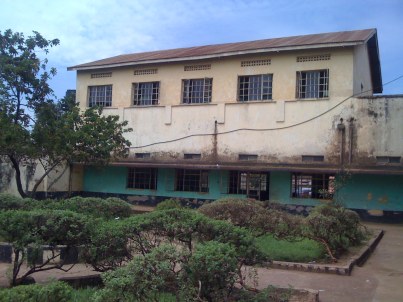
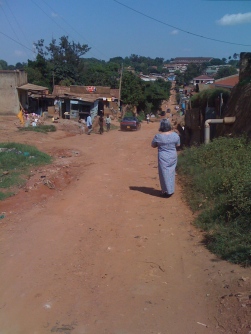
2008-06-11 13.06.14The endeavour in Kampala is very noticeable: seemingly chaotic but more a sense of heightened hustle and bustle without the tension which was in the streets and newspapers of Nairobi. White lines on the road from the airport was a good start, although the majority of them are pit-holed, roughened up and shot to pieces. You can see why you need an off roader here as the roads themselves are more off road than on road, what with the melted, rippled and solidified tarmac at their sides, the flaking away into the earth and the general chronic wear and tear.

There ain’t nothing as authentic as your memories. We are looking for authentic matoke which has to be cooked properly (a la memory) and added to the right sauce. It’s comforting that the hotel is flanked by armed guards but talk on the TV of the Sudanese seeing the interventions of the LRA as an act of war is not so comforting. This will be a week of searching for authenticity and it might end in tears.

2008-06-11 12.36.57Day 4
The search for authenticity continues. Distances walked from home to school once seemed huge and never ending; when older they’re seen / they see us as short as from here to the next corner. The memory has been shrunk wrapped so that the journey is now no more than couple of blocks. Likewise, the house which at once seemed so large with innumerable rooms and possibilities is now no more than a modest shack in a compound with its crumbling walls and washed public spaces in which children play with meagre resources but ample imagination.

2008-06-11 15.15.48Day 5

It’s only memory that allows for spaces, possibility and heightened sensual experience. The revisit, the return, shrink wraps and diminishes. At best the terrors of the memory are perhaps lessened, made mundane and domesticated by the revisit and the horror can metamorphose into the ridiculous and the pathetic: at worst, the revisit causes the joys of the memory to be likewise sanitised, and recast into a new perspective which holds less import, moment or potential.

2008-06-11 15.54.50Day 6
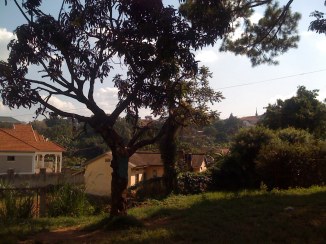
We have spent many hours wandering in and out of I remembers and walking down memory lanes, putting bits of memory together. Confusion sets in once in a while when I remember those trees turns into those trees remember me and I’m left wondering whether spaces and places miss and yearn for us as much as we miss and yearn for them. Ironically, the search for authenticity when it gets close, results in a temporary emotional choking up, a temporary amnesia which means we forget more or less everything about that memory and the drive to authenticity that that memory induced.

And we speak of memory as if it is an intact entity, boundaried and discreet: perhaps a memory is more of a composite of senses, reflections, images, sounds, tastes and smells which coalesce occasionally to produce “a memory”.

2008-06-11 12.37.19Day 7
Capturing memory has been like trying to step into the same stretch of river twice. The river keeps flowing, nothing stays the same despite the appearance of the river bank, undergrowth and other assorted peripherania.

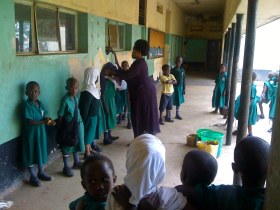
Things have flown away, the waters have traversed the ground carrying assorted flotsam and jetsam it collects, is donated or mysteriously acquires through some kind of adjacent leakage. The river keeps flowing, trying to capture and fix the memories is in vain, it’s all in vain…. as the children in the orphanage sang earlier this week.

2008-06-11 15.34.05

The knowledge of the car driver: Number 5 in an the series: Knowledge, traffic and arts based research.

The knowledge of the car driver is perhaps the most complete form of knowledge available to us in both the private and public spheres of knowledge. He (for the car driver is always male, the form has not yet found a way of accommodating female insights into how to navigate oneself around the world) knows how to use Satnav, A – Z or his own innate capabilities in recognising how the world roads systems should connect up; how to surround himself with the perfect soundtrack which mirrors how his own internal emotional turmoil connects to his public confidence in the morals of the highway code; and  how his mpg will accurately predict his eta. On a good day, the drivers knowledge is both organic and inorganic,  both evolved and constructed: man and machine are perfectly melded. On a bad day, you find yourself on the M25.

Arts based research has a particularly effective role to play if the driver finds himself on the Moebius Loop that is the modern outer city motorway. Poetry, site specific installations and bricolage can be bought into play on the car dashboard, creating new interpretations on ancient themes of mans inhumanity to man, the place of God in a Godless society and the existence of the Devil. The only risk to the driver is that by becoming so immersed in the knowledge that this research generates, they miss the turning for the Dartford Tunnel and are doomed to repeat their journey for a further 120 miles.

More travel knowledge here.

Everybody dance now! – revolutionary songs continue to drive the revolution through the rhetoric of crisis

The Arts in Schools: Principles, practice and provision was published by the Calouste Gulbenkian Foundation in 1982; it was followed some 17 years later by All Our Futures Creativity, Culture and Education, published by NACCCE, the National Advisory Committee on Creative and Cultural Education. Both documents can trace their heritage to Half Our Future, a report of the Central Advisory Council for Education (England) published in 1963 and chaired by John Newsom, which, in its turn pays homage to the work of Herbert Read and his 1957 conference report for the Joint Council for Education through Art, Humanity, Technology and Education.

In setting out their argument to reposition arts education (in 1982) and creativity and cultural education (in 1999) in the curriculum, the documents argue from the position that as we live in unprecedented times, with unprecedented challenges, it is essential that educational policy makers and practitioners look to a future which commits to the centrality of arts or creative education in the development of school cultures and curricula.

In the Gulbenkian report, these ‘unprecedented challenges’ revolve around patterns of employment, the relationship between education and society and the nature of cultural change in Britain. These changes are heightened by various ‘threats’ of ‘falling school rolls, cuts in public expenditure and some of the demands of educational accountability’ and are characterised in a language of despair: ‘actual provision for the arts in schools, so far from getting better, is facing serious deterioration’ ; ‘nationally, the situation is bleak and becoming bleaker’.

All Our Futures, published by NACCCE in 1999 and chaired by Ken Robinson, starts in a similar tone. ‘Education faces challenges that are without precedent which it repeats, (‘Education throughout the world faces unprecedented challenges: technological, social, and personal.’) and then elaborates upon: ‘the benefits of success are enormous and the costs of inaction profound’. From its first pages, the report argues that the need for creative education is predominantly economically driven:

In 1997, the Government published its White Paper Excellence in Schools. It described education as a vital investment in ‘human capital’ for the twenty-first century. It argued that one of the problems in education is the low expectations of young people’s abilities and that it is essential to raise morale, motivation and self esteem in schools. The main focus of the White Paper was on raising standards in literacy and numeracy. But this will not be enough to meet the challenges that face education, and the White Paper recognised this…. It emphasised the urgent need to unlock the potential of every young person and argued that Britain’s economic prosperity and social cohesion depend on this. This report argues that a national strategy for creative and cultural education is essential to that process.

Robinson has continued to communicate this message of unprecedented change in education and the link to economic well being. At a key note address to an international conference in Holland, for example, he expressed his view that the debates on creativity and the relationship of arts within the curriculum had a global significance: ’the truth is that every educational system represented at this conference, every education system everywhere, is facing a revolution.’

The quasi-apocalyptic views that Robinson has expressed over the last 25 years are not new and his is not the voice of the lone prophet in the wilderness. Robinson himself is an echo of earlier voices in the English education system broadcasting much the same message of the need to redress the place of arts education within the curriculum. For example, at the conference held by the Joint Council for Education through Art in 1957, Blackham concluded:

We believe that neither the contribution of the arts to general education, nor the place of general education in the national life has yet been properly recognised, and we want to form a body of enlightened opinion drawn from all walks of life which will bring general public opinion to share our conviction and see our vision of the role of the arts in general and the role of general education in the life of our industrial mass society.

The Gulbenkian report refered back to this conference, insisting that ‘It is all the more poignant… that this is a struggle in which we are now, even more pressingly, engaged 20 years on’. Now, a further 54 years on from that report, it is telling that variations on the same theme are being heard from arts educators not just within the UK but around the world.

As James Callaghan once (didn’t) say: Crisis, what crisis?

Extract from
When Herbert Met Ken: Understanding the 100 Languages of Creativity English in Education / National Association for the Teaching of English, Vol. 41 No. 2., 2007.
Available at
http://aspire-trust.academia.edu/NIckOwen/Papers/881601/When_Herbert_met_Ken_understanding_the_100_languages_of_creativity

Original references removed for the sake of brevity.

More at: https://drnicko.wordpress.com/2012/04/02/rejoice-a-little-known-connection-between-creativity-cultural-education-and-the-falklands-malvinas-campaign/

The Education revolution starts TODAY! The radicals, at last, have all the best tunes.

Whilst Pink Floyd indicated their intent to start an educational revolution in the 1980s with their rousing ‘We Don’t Need No Education” (ironically indicating to the pedants amongst us exactly why some education was needed when it came to communicating to the rest of the English speaking world – it’s ANY education, Jones – not NO education – do keep up boy!), the most recent education revolution started TODAY at the recent TEDXLondon event at London’s Roundhouse.

And like all good revolutions, the Education Revolution is being broadcast through popular song with the revolutionaries on the stage proclaiming their intent through a collection of songs which will no doubt find their way onto ITunes in time for Christmas, or at least every school’s Nativity Play.

(Go work down) On the Waterfront is an exhilarating rehash of the old Simple Minds classic: it will be a treat to see them rejuvenate themselves and bring that thumping great bass line, simplistic memorable lyrics and exhortation to bring in the ‘real world of work’ into the imaginary world of the classroom.

Let’s Make Mistakes Together will be a soulful ballad delicately performed by Will Young and a backing chorus of X-Factor rejects who have been picked up off the audition room floor by Will, given a dusting down and placed on the road to fame and fortune.

I am me because of us is a defiant anthem which Celine Dion has penned but which U2 will be treating with a newly invigorated Eno at the mixing desk and Chumbawumba offering free style rabble rousing. Expect the addition of a further guitar courtesy of Paco de Lucia and the sampled ukele of George Formby.

Emily is one of the top ten outstanding people in the world is a remake of the lost Belle and Sebastian track from the 1998 album, Boy with the Arab Strap. It wasn’t a particularly impressive number then but with Goldie at the mixing desk, things can only get better as Ken Robinson was heard to be singing over the weblink.

She made a self-sustaining fridge for West Africa has been especially commissioned from Ray Davies, formerly of The Kinks, but still showing his penchant for English whimsy. ‘Self Sustaining Fridge’ is reminiscent of his early 1960s album, Arthur, on which She Bought a Hat Like Princess Marina” was an audience favourite at the Marquee (just around the corner from the Roundhouse, funnily enough).

So although the education revolution starts TODAY and no-one’s too sure who’s leading this, who the guerillas are, where the anarchists are in the mix and where the collateral damage is going to occur, we can all at least be confident that this revolution will at least have some decent songs, downloads, tracks and other commerical spin offs.