Pitch a Film on a Friday: shaking up the habits of the film going public

In these days of austerity, going out to the cinema is beginning to cost more than a good night out. You’ll need to be thinking about parking, candyfloss, 3D glasses, meal after and before, a few drinks in the intermission never mind the price of the seat. And then there are all those interminable adverts to sit through!

So why not settle back, buy in a few six packs and create the film in your own head?

Pitch a Film on a Friday allows you to do exactly that. By giving you – absolutely free – a pitch for a film that hasn’t yet been made, this blog enables you to become your very own film maker, casting agent, distributor, audience and critic all rolled into one. You can even imagine your own awards ceremony! And as for the overwheening power of Hollywood? This is the place to put Hollywood firmly in its place!

Pitch a Film on a Friday is released every Friday (surprisingly) just in time for the weekend. Settle down, settle back, put away your credit card and throw away your parking worries: the film is in your head and its just about to begin!

Find all Friday pitches here.

The Saturday Rough Guide: Devising Community Theatre

Devised theatre is something you either fear and loath, in which you dread the personal haranguing, the criticism from peers and the complete and utter lack of confidence in the material you have come up with…

… or it can be something you come to love and respect in which you are exhilarated by the challenges it presents, the surprises it generates and the moments of understanding and clarity it presents.

When it works well, you come to realise that there’s nothing (much) else in the world that’s worth the aggravation…

… for the rest of us mere mortals the trick is to survive it and try and enjoy it somewhere along the line.

The devising process is as individual as there stars in the heavens: what shines for one person becomes a imploded neutron star of despair for someone else. Consequently this is not a definitive, authoritarian guide. It should be seen as a series of possibilities which you should adapt and tailor to you own particular style and ‘voice’.

THE PROCESS

Devising is a bit like a completing a jigsaw puzzle without having the benefit of having the box top with the completed picture in front of you. There is no mystery to making devised work: the trick is, as our old Danish colleague, Jakob Oschlag, pointed out is to:

KNOW WHERE YOU ARE IN THE PROCESS

If you have worked on devised work before, you’ll recognise that sections of the process (outlined below) can bleed into each other; you’ll also recognise sections which you’re particularly good at and particularly poor at.

In summary they might go like this…

1. Gather and collect: Personnel, ideas, facts, figures, whims, daydreams, ‘what ifs’, impossible scenarios, dull ideas, bright ideas, snatches of speech, the flotsam and jetsam of everyday and not so every day life.

2. Building components: Where are the connections between your collections? What do they lead to? What links suggest themselves?

3. Building infrastructure: Finding the world your production inhabits, its main protagonists, its central ideas, its main arguments.

4. Shaping: Combining the components into the infrastructure. Not being afraid to jettison structures that don’t fit (they may belong to another project which you are unaware of at this point in time) or changing the infrastructure itself. “Killing your darlings” is a phrase you might hear here a lot.

5. Focusing: Focusing the form and content of your piece; being sure that everything in it has a purpose, a role and a function. Making sure essential bits aren’t left out and that un-necessary bits aren’t left in.

6. Rehearsing: Getting the work into a fit shape for presentation. Concentrating on production values to ensure a polished, confident and convincing piece of work.

SOME COMMON HURDLES AND STEREOTYPES YOU’LL ENCOUNTER ALONG THE WAY

1. Anything goes… but everything need not stay
Somewhere at the beginning of the process you are likely to experience that blood rush of having lots of exciting, creative ideas which you are burning to tell the whole group about and get them to take it on board. This is fine and natural and absolutely right for the beginning of the process.

Chances are though that probably everybody will go through that in the group… and that whilst it is the group leaders responsibility to try and look at every idea coming to them , they are not likely to commit to every idea that arrives.

The process of sifting and editing is an essential part of editing; and whilst you may have the most glorious idea and vision, you should accept that it may not be suitable for the particular piece at that particular time and you should be prepared to let that idea drift away should the time come.

This is painful first time round, especially if you have spent a great deal of energy coming up with the idea in the first place but is something you need to come to terms with. Kill Your Babies is something you might hear a lot here.

The thing to remember is that your idea, whilst not necessarily visible, will have caused innumerable and indefinable connections and ideas to have surfaced and so will have had a valuable function in helping create the final piece.

Its also worth remembering that if you get hung up on ‘your idea’ or ‘my idea’ or ‘their ideas’ that actually, ideas belong to no-one and are ten a penny. Ideas are important but not sufficient in their own. Bringing them to a public is as important as their initial generation.

2. The Company of 0 Directors

In an attempt to be democratic, the company of 0 Directors has an individual (the invisible director) who tries their hardest to be the nice guy, the one who wants to minimise (or avoid) conflict and is loathe to upset anyone. The invisible director refuses to make any decision about the project and usually includes every single contribution gathered. This often leads to a piece which is variously seen as surreal or confusing or a mess. It might challenge existing structures or notions of art work but then again it may not: the danger is that it will confuse and dispirit the participants, leading them to feel they won’t get involved in anything ever again. This can lead onto the next syndrome:

2. The Company of 1000 Directors

The first phase of devising is often a very creative, stimulating and exhilarating time what with so much creativity and energy flying around the rehearsal room. However there comes a point, maybe a third of half way into the process where someone needs to start shaping the ideas and structuring them into a performance. This is usually the job of the director (or MD or writer or choreographer) and you may find the way they work a bit alarming after all the freefloating energy and sense of democracy which should have prevailed up until the time they step in.

They may appear short-sighted, blinkered, unlistening or even rude and abrupt. This is because at this point in the process, it is essential that decisions regarding the final structure and content of the piece need to be taken and something approaching the ‘vision’ of the piece needs to established and communicated. Chances are this is best done by a director working with the MD or other relevant staff on the project.

In the absence of this structuring job, the company may revert to the Company of 0 Director syndrome. The temptation often for the other devisors at this point is to chip in and start directing everybody else in the group. This way anarchy lies, especially with a large group, and is something to be avoided where possible.

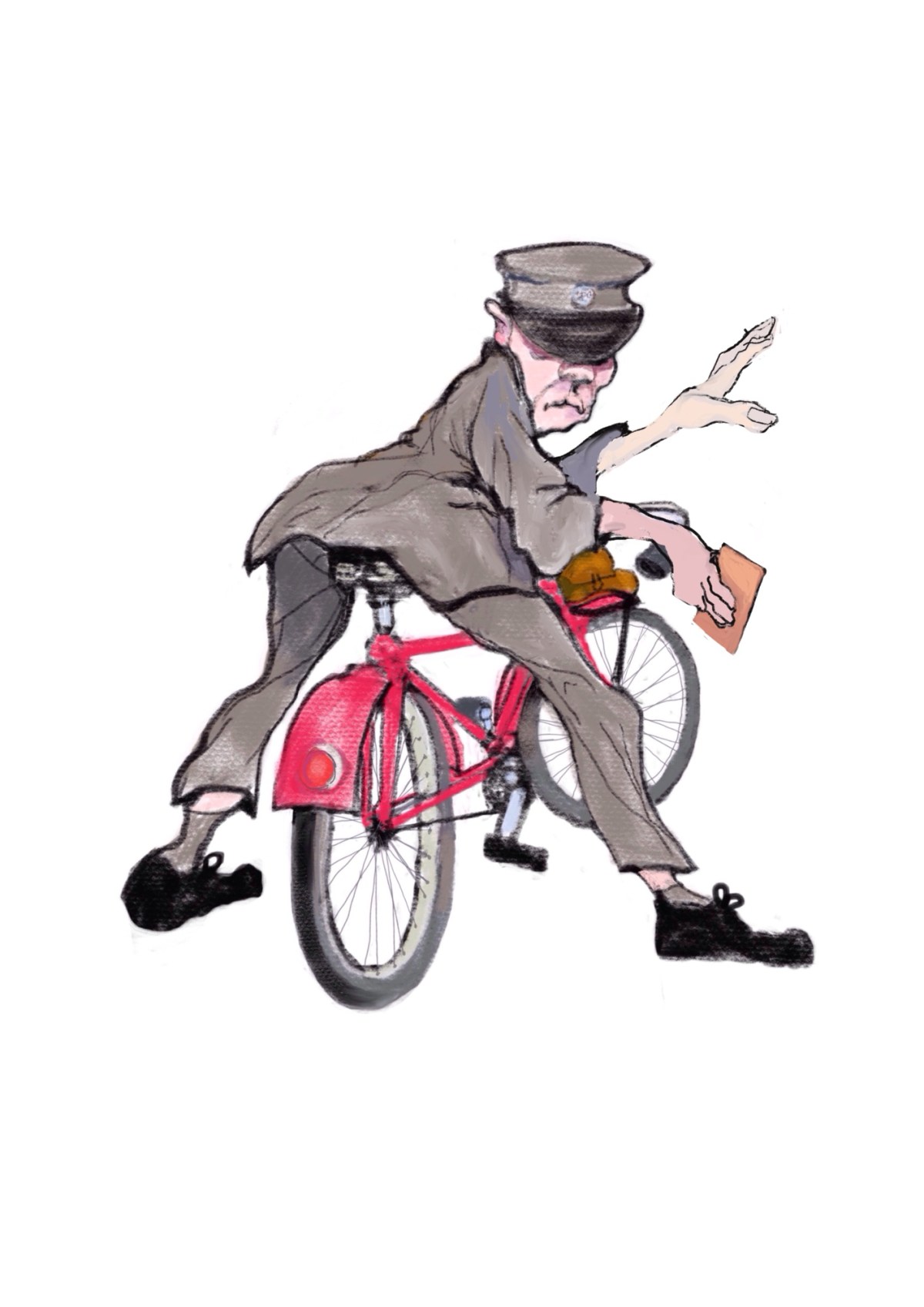
Pitch a Film for a Friday: STUCK!

And you may ask yourself, well, how did I get here?
Talking Heads, Once in a Lifetime

A series of twelve five minute observational vignettes, Stuck portrays the tragi-comic stories of 12 people who are stuck: stuck in what look like bizarre routines to outsiders but to themselves, make perfect sense of their everyday if somewhat unconventional – some might say unsettling lives. It’s about outsider’s attempts to ‘unstick’ those people and connect them with ‘normality’ – when it was a bad dose of ‘normality’ which is what put our characters in their predicament in the first place.

Stuck-ees include:

Edith, 70, lives in an OAP home – she’s Polish, had – according to her photo album – a life of partying, family and good times – but now, after a stroke, can only speak 15 words of Polish in a perpetual cycle, broken up by her occasional and obvious frustration that she can’t say anything else. Her speech therapist tries to snap her out of this cycle using a variety of speech therapy methods – and just when she thinks she’s about to succeed, it appears that Edith resorts to her 15 word mantra, thwarting her therapist, her family and perhaps herself.

Paul, an old man of indeterminate age or background who cycles up and down the same road in Liverpool, searching the bins, very early every Monday morning. His encounters with the local traffic police and milk men offer no clues as to why he takes this route everyday but a wheelie bin cleaner has taken to Paul and attempts to connect to him by talking to him daily, engaging him in conversations about peoples bins and finding out what makes him tick – or what makes him stuck.

Ben, a 29 Geordie ex-student of 8 years who since leaving college has developed a highly successful business in selling Class A drugs. His business has various unsocial side effects though – and consequently he has found himself housebound, a prisoner of his success for the last 3 years, unable to make any contact with anyone outside his bedroom, kitchen and bathroom.

STUCK offers no sociological explanations or theories to our character’s ‘stuckiness’ but offers us an opportunity to review our own habits, obsessional behaviours and opportunity to ask ourselves, ‘well, how did I get here?’

Flow: prayer for a provisional ending

As life begins
The circle of evolution continues
Life flows through my body
like the wind blows through nature.

Flowing beside the city
Beside the river
Down by the docks
Along the far side of the port,

My words and stories evolve into thoughts and memories
and through these
my world becomes a performance.

A place where the boats fill up
The seagulls fly straight
And the passengers look out
To a place and time

Where my imagination flows
My humanity becomes a performance
Where possibilities begin
And end and begin again.

The tide surges
It falls back
The salmon are left on the shoreline
Waiting for the signals

To call them back
To the ocean
And back to the stream
They left in their youth.

But will the flow ever end?

Composed with Emily Frodsham on the morning of the death of Steve Jobs, as part of the final performance of the Flow Community Arts Autumn School, Sigdal, Norway.

Geoff Pennycook, in memoriam.

Poetry on the Hoof: Terraced? Semi? Detached? Year 7 plan their future homes.

You gotta decide the lighting,
It’s November, remember.
You gotta agree,
Sort it out reasonably.
You gotta think it out,
You’ve gotta act quick.
Silence hush descends.

You’ll need pools of light
You’ll need water, air, space.
Somewhere to park the car
When the days close in.
Can I get a red phone box?
Can I get an allotment?
Silence hush descends.

You’re gonna see nothing
With windows like that.
You’re gonna be a resident, remember.
You’re gonna freeze to death
With walls like that.
Are we gonna pretend?
That we have to pay mortgages an’ ‘owt?
Silence hush descends.

You gotta make a choice,
Or you’re gonna get stuck.
Best to say little,
If you’re not sure.
If you don’t wanna pay for ‘owt can we live in a toilet?
We could use our imagination.
Silence hush descends.

Everyone’s gotta live somewhere
Everyone’s gotta have a place
They can call their own.
But if you’re gonna want a family.
But if you’re gonna get you a mortgage,
You gotta be quick,
You gotta be sharp,
You gotta get rid of those ghosts that moved onto your land.
Silence hush descends.

Some responses by then young people of Kingstone School, Barnsley to recent exhortations to a ‘Housing Revolution’. Readers may be interested to know about similar revolutions being plotted in education.

The rhetoric of crisis is also echoed in housing and education too here.

What’s different about the development of International Community Artists? Flowing towards international community arts practice in Norway

To re-write Peter Brook in his 1987 book, The Shifting Point:

What do we need from performance? What do we bring to the event? What in the artisti process needs to be prepared, what needs to be left free? What is narrative? What is character? Does the event tell something or does it work through a sort of intoxication? What belongs to physical energy, what belongs to emotion, what belongs to thought? What can be taken from an audience, what must be given? What responsibilities must we take for what we leave behind? What change can a performance bring about? What can be transformed?

Big questions from a big man and exactly the questions emergent community artists should always be asking of themselves.

What are we looking for from those young artists? And how does their training differ from an actor’s, or dancer’s or visual artist’s training? What are the differences between an ‘actor’ and a ‘performer’ in a community based context? Whilst arts skills are clearly essential for fledgling artists, are they the be-all and end-all?

Artists working a community contexts may well find themselves working in a number of different contexts which require them to play very different roles:
* actors in a Theatre in Education (TiE) shows
* Master of Ceremonies (MC) in a club or community centre,
* teachers in class,
* preachers in funding meetings
* actors in a ‘straightforward’ show in a theatre,
* facilitators with a group of young people,
* interactive performers in a museum or gallery,
* as a TV, video or radio presenter.

The relationship of the performer to ‘text’ is an interesting issue to start exploring. A lot of performance work may be in devised / improvised productions in which ‘text’ will not necessarily be language based, and is often unlikely to be the first impulse to a production. ‘Text’ as we know it may not even appear until after the production has ‘finished’.

Our relationship with ‘The Author of the Text’ who is somehow above or separate to our process will be radically different from a context which is designed to honour and respect the word of the author above everything else. One consequence of this could be, for example, that we have to reconsider whether and when the notion of us developing in-depth character psychological profiles, performed in naturalistic, ‘4th Wall’ settings which require little in the way of audience participation are of relevance to us.

Flowing towards contemporary community arts practice continues to exercise the youngest and oldest of practitioners and the advent of social networking in recent years means that old assumptions about the identity of individuals and groups has to be completely re-thought.

Further work on Flow: the Norwegian International Autumn School in Community Arts in Sigdal, Norway, here:

Pitch a Film on a Friday! A Beggarly Account of Empty Boxes: a 5 minute Romeo and Juliet with a cast of 1 and 2 dummies

It’s Brighton Pier, late Autumn. There’s an end of the pier show about to take place in the theatre, late on a Wednesday afternoon. It’s cold, desolate. Signs are banging in the wind, advertising…

“Father Larry presents…. Shakespeare as you’ve never seen before! Come wonder at the marvels of modern science!”

A lacklustre audience of end of the pier visitors drift out of the theatre and idly kick their heels around, waiting for the start of the main attraction – Father Larry.

A shifty looking Vicar – Father Larry – rushes up the pier, straightening up his dog collar, adjusting his trousers, wiping the lipstick off his collar and generally trying to tidy himself up and make himself respectable. He avoids the audience gathering by the front door of the theatre and squeezes himself through the stage door whilst no-one is looking.

He’s had a quick couple of scotches in the interval as a desparate attempt to continue the audience suspension of disbelief for the final 30 minutes of his show. He heads back stage to his dressing room, avoiding the stage hands and curses of the theatre manager.

Back stage, Father Larry’s dressing room. 2 large cane crates are placed in the centre of the room, with two large ventriloquist dummies left carelessly on top of them, limbs askew, clothing untidy. One’s a dummy of a young girl – Juliet – the other of a young boy – Romeo.

They both are trying to hold a conversation with other dummies which are stored away in the crates. It becomes clear they’re from two warring families – both are exhorted to return back to where they came from – their crates – by their families inside the crates and both agree that’s what they’ll do as soon as they’re physically able to do so.

They can’t stand the sight of each other as it happens anyway – they trade insults relentlessly and try to move their wooden bodies into a position where they could be taken back to the bosom of their families.

Father Larry crashes into the dressing room, swearing and sweating profusely. He’s been told that unless he sharpens his act up, he’s out of a job from the end of the afternoon. It’s been a disaster out there on stage and he’s got minutes to redeem himself and his act. His livelihood is nearly over.

He gets hold of the dummies angrily and tries manipulating them to talk to each other, to care for each other. They do as he says – although we sense their own individual dummy reluctance.

He acts out their family quarrels, disputes and expectations and urges them to love each other, much against their will. They comply but find subtle ways of resisting – falling of their crates, asking for a gottle of geer, that sort of thing.

He gets angry and bullies them into doing as he decides. He forces them into uncompromising sexual positions. They resist, he breaks them up, one by one, piece by piece. His act and livelihood are falling apart before his eyes.

When the pieces of the dummies have been flung across all corners of the dressing room, he realises what he has done. He’s distraught and tries putting them back together again, in vain. He tries to exert his religious influence on them, but to no avail. “A plague on both your houses!” he hisses at them. They both end up badly and violently damaged, strewn across the floor of the dressing room.

There’s a knock on the door. The second half of the show is about to begin. His time’s up. He has no option but to go on stage, empty handed. He tries playing out the role of the dummies himself but the audience see through him and drive him off stage.

He staggers woodenly down to the end of Brighton Pier, unable to shake off the dummy mannerisms that he’s adopted. His complexion has turned grey, his eyes – a mad staring look, his mouth – fixed in a permanent grin. “Good night, good night! parting is such sweet sorrow,” he mutters to himself. He stares out at the sea, tears rolling down his cheeks whilst still continuing to smile.

MenschMachine: Kraftwerk takes on the Medics and the NMR Industry

I’m led into a modest clinic, disinfected, spartan, imposing. A large nuclear magnetic resonance imaging device takes centre stage. I am told to lie down on a table , hold my arms in a fixed position, place my chin on a poystyrene pad and not to move. Apparently all my hydrogen ions are about to cajoled to spin in one direction – altogether now. The ones in my water molecules will spin at a different rate than the ones in my lipid molecules and they – the nurses, not the molecules – will be able to determine how healthy I am and whether I’ve spent to much time in the bar in recent years.

Slowly, the slab I’m on enters the machine and the chorus of clicks whirrs thuds hums and clanks kicks off. It’s like living in a Kraftwerk album, but in one of the lesser, in progress tracks. But its not unpleasurable. Intriguing with a laser green light just a few inches above your head and reminiscent of the Expo 2000 track they produced.

The clicks whirrs and thumps continue at regular intervals until the slab rolls back out of the machine. I’m told to turn over, tuck that in, loosen that and don’t forget to breathe. The process starts again for a further 10 minutes. This time you’re given head phones as the sound can reach upto 120 decibels apparently. Something you might be familiar with smirks the nurse.

On the way out of the clinic you realise that you have just been examined by a Magnetom Magnetic Resonance Imaging machine which goes under the delightful name of the Symphony Maestro.

I don’t know why I’m surprised. The whole event has been a sub-orchestral event with some very low bass notes played in counterpoint to some ultra ultra high frequencies which only the local sewer rats can hear. It has been Kraftwerk at their most uninspiring. But fundamentally, this has been a musical event, not a medical one.

I realise I am used to Kraftwerk making all kinds of molecules vibrate in all kinds of ways in recent years and reckon that the health information you could gather from listening to Tour de France for an hour would yield much better health benefits than the diagnostics the Symphony Maestro will be able to generate.

The event emphasises that the connections between arts and health – and in particular music – are closer than many nurses and doctors might like to admit to. Music is my first love warbled John Miles many years ago; this may be true but it might be more accurate to say that it is also our first way of connecting with the world through how its frequencies make our molecular structures resonate: although that would hardly be the title of a top ten hit, now, would it?

Poetry on the Hoof: Triangulated Data (v1.0)

Did he? Did she?
Does She?

Will he? Will she?
Would (will) She?

Did they? Would they? (if they did…)
Would She? (have…)

Maybe they did? Maybe they didn’t? (perhaps they couldn’t?)
Maybe She would maybe She wouldn’t (perhaps She couldn’t?)
But perhaps they did, perhaps they could have,
Perhaps She might, perhaps She would have,
Perhaps She dared where they feared
To tread
And perhaps they couldn’t.
When She would and could have
And perhaps they all just might have
Conspired, together, in cahoots
A perfect triangle
A seamless bubble
A little bit of surreptitiousness in the undergrowth.
Perhaps (they did) perhaps…