Disneyworld as the aspirational role model for schools: just what’s so wrong with that?

Read on Twitter yesterday: Overheard a primary school learner describe a visit to a nearby high school as “this is like Disneyland”. It really was that good…

How tremendous would that be. School as an outpost of Disneyland and all its aspirational urgings: Let the memories begin…Explore the happiest place on earth…Welcome to the magic… all powerful metaphors which are hugely seductive for children, teachers and families.

And what’s so wrong with these metaphors? Why shouldn’t schools be the happiest places on earth? Perhaps there’s far too little magic in schools and a dose of Disneyfi-ed magic would do everyone a power of good? As a place to ‘let the memories begin’, its difficult to contradict the proposition that schools should be just that – places which shape memorable memories, shape our lives and futures and all that is good in the world.

And this is of course exactly the problem with the Disney model of school development and community building. There is no argument against it. It is impossible to critique the desire to be at the happiest place earth, the welcoming force of magic and a place for memory making. The Disneyfication of the school is the full stop at the end of the question which asks what schools are for.

Where is the place for resistance? For criticality? For unreconcilable difference? In short, no-where. There is no room for resistance in Disney. It is, as the Borg constantly remind us, futile. Any and all conflict in Disney is moderated, sanitised and overcome. The hero and heroine will always overcome the forces of the awkward buggers who get in their way. The awkward squad might be entertaining, or seductive in their repulsiveness: but one thing they never become are winners.

The individual- the Disney Hero – will always triumph in the Disney School: this is sometimes presented as being for the benefit of the individual themselves, at other times for the benefit of a wider, grateful community. Whatever else, the individual is central to all of Disney’s concerns. Nothing else matters as much as ensuring the desires of the individual are fulfilled. In that sense, the Disney school is the natural endpoint of the personalised learning agenda.

Which is where the combination of Disney and School in the same sentence becomes a potential nightmare because it generates the demand above all else that the child’s view is paramount. That their desires, interests, fashions and choices are all that matter; that the only function for teachers or other adults is to ensure their voices are heard and their demands met. In the Disneyfi-ed, personalised school, the child is in a 24/7 sweet shop, entranced by the baubles, hypnotised by the bangles, flattered by the flickering lights and fed, up to their back teeth, with the educational equivalents of coca cola, candy floss and Peter Pan.

But school is not a sweetshop. It should of course be magical and memorable and a place for happiness: but we should also welcome the reality that school is – and needs to be – tough, that learning is difficult, challenging and sometimes – dread word – boring. School – education – life – is a struggle, not a sherbet dip.
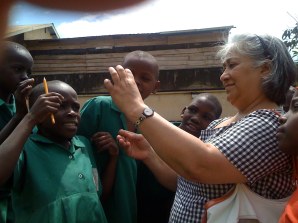
Uganda, day 3: searching for authenticity

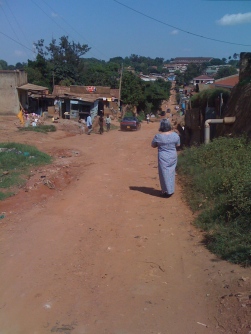
2008-06-11 13.06.14The endeavour in Kampala is very noticeable: seemingly chaotic but more a sense of heightened hustle and bustle without the tension which was in the streets and newspapers of Nairobi. White lines on the road from the airport was a good start, although the majority of them are pit-holed, roughened up and shot to pieces. You can see why you need an off roader here as the roads themselves are more off road than on road, what with the melted, rippled and solidified tarmac at their sides, the flaking away into the earth and the general chronic wear and tear.
There ain’t nothing as authentic as your memories. We are looking for authentic matoke which has to be cooked properly (a la memory) and added to the right sauce. It’s comforting that the hotel is flanked by armed guards but talk on the TV of the Sudanese seeing the interventions of the LRA as an act of war is not so comforting. This will be a week of searching for authenticity and it might end in tears.

2008-06-11 12.36.57Day 4
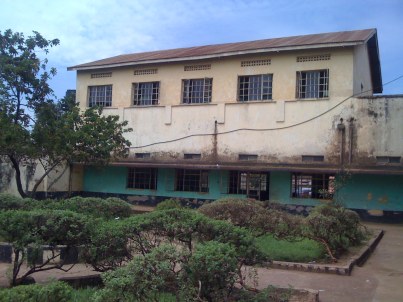
The search for authenticity continues. Distances walked from home to school once seemed huge and never ending; when older they’re seen / they see us as short as from here to the next corner. The memory has been shrunk wrapped so that the journey is now no more than couple of blocks. Likewise, the house which at once seemed so large with innumerable rooms and possibilities is now no more than a modest shack in a compound with its crumbling walls and washed public spaces in which children play with meagre resources but ample imagination.

2008-06-11 15.15.48Day 5

It’s only memory that allows for spaces, possibility and heightened sensual experience. The revisit, the return, shrink wraps and diminishes. At best the terrors of the memory are perhaps lessened, made mundane and domesticated by the revisit and the horror can metamorphose into the ridiculous and the pathetic: at worst, the revisit causes the joys of the memory to be likewise sanitised, and recast into a new perspective which holds less import, moment or potential.

2008-06-11 15.54.50Day 6
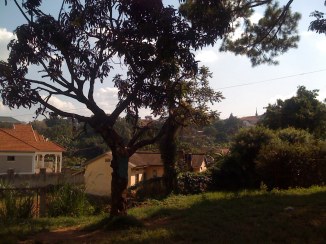
We have spent many hours wandering in and out of I remembers and walking down memory lanes, putting bits of memory together. Confusion sets in once in a while when I remember those trees turns into those trees remember me and I’m left wondering whether spaces and places miss and yearn for us as much as we miss and yearn for them. Ironically, the search for authenticity when it gets close, results in a temporary emotional choking up, a temporary amnesia which means we forget more or less everything about that memory and the drive to authenticity that that memory induced.

And we speak of memory as if it is an intact entity, boundaried and discreet: perhaps a memory is more of a composite of senses, reflections, images, sounds, tastes and smells which coalesce occasionally to produce “a memory”.

2008-06-11 12.37.19Day 7
Capturing memory has been like trying to step into the same stretch of river twice. The river keeps flowing, nothing stays the same despite the appearance of the river bank, undergrowth and other assorted peripherania.

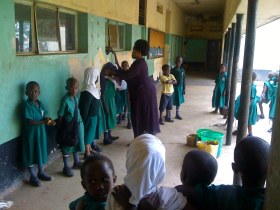
Things have flown away, the waters have traversed the ground carrying assorted flotsam and jetsam it collects, is donated or mysteriously acquires through some kind of adjacent leakage. The river keeps flowing, trying to capture and fix the memories is in vain, it’s all in vain…. as the children in the orphanage sang earlier this week.

2008-06-11 15.34.05

Everybody dance now! – revolutionary songs continue to drive the revolution through the rhetoric of crisis

The Arts in Schools: Principles, practice and provision was published by the Calouste Gulbenkian Foundation in 1982; it was followed some 17 years later by All Our Futures Creativity, Culture and Education, published by NACCCE, the National Advisory Committee on Creative and Cultural Education. Both documents can trace their heritage to Half Our Future, a report of the Central Advisory Council for Education (England) published in 1963 and chaired by John Newsom, which, in its turn pays homage to the work of Herbert Read and his 1957 conference report for the Joint Council for Education through Art, Humanity, Technology and Education.

In setting out their argument to reposition arts education (in 1982) and creativity and cultural education (in 1999) in the curriculum, the documents argue from the position that as we live in unprecedented times, with unprecedented challenges, it is essential that educational policy makers and practitioners look to a future which commits to the centrality of arts or creative education in the development of school cultures and curricula.

In the Gulbenkian report, these ‘unprecedented challenges’ revolve around patterns of employment, the relationship between education and society and the nature of cultural change in Britain. These changes are heightened by various ‘threats’ of ‘falling school rolls, cuts in public expenditure and some of the demands of educational accountability’ and are characterised in a language of despair: ‘actual provision for the arts in schools, so far from getting better, is facing serious deterioration’ ; ‘nationally, the situation is bleak and becoming bleaker’.

All Our Futures, published by NACCCE in 1999 and chaired by Ken Robinson, starts in a similar tone. ‘Education faces challenges that are without precedent which it repeats, (‘Education throughout the world faces unprecedented challenges: technological, social, and personal.’) and then elaborates upon: ‘the benefits of success are enormous and the costs of inaction profound’. From its first pages, the report argues that the need for creative education is predominantly economically driven:

In 1997, the Government published its White Paper Excellence in Schools. It described education as a vital investment in ‘human capital’ for the twenty-first century. It argued that one of the problems in education is the low expectations of young people’s abilities and that it is essential to raise morale, motivation and self esteem in schools. The main focus of the White Paper was on raising standards in literacy and numeracy. But this will not be enough to meet the challenges that face education, and the White Paper recognised this…. It emphasised the urgent need to unlock the potential of every young person and argued that Britain’s economic prosperity and social cohesion depend on this. This report argues that a national strategy for creative and cultural education is essential to that process.

Robinson has continued to communicate this message of unprecedented change in education and the link to economic well being. At a key note address to an international conference in Holland, for example, he expressed his view that the debates on creativity and the relationship of arts within the curriculum had a global significance: ’the truth is that every educational system represented at this conference, every education system everywhere, is facing a revolution.’

The quasi-apocalyptic views that Robinson has expressed over the last 25 years are not new and his is not the voice of the lone prophet in the wilderness. Robinson himself is an echo of earlier voices in the English education system broadcasting much the same message of the need to redress the place of arts education within the curriculum. For example, at the conference held by the Joint Council for Education through Art in 1957, Blackham concluded:

We believe that neither the contribution of the arts to general education, nor the place of general education in the national life has yet been properly recognised, and we want to form a body of enlightened opinion drawn from all walks of life which will bring general public opinion to share our conviction and see our vision of the role of the arts in general and the role of general education in the life of our industrial mass society.

The Gulbenkian report refered back to this conference, insisting that ‘It is all the more poignant… that this is a struggle in which we are now, even more pressingly, engaged 20 years on’. Now, a further 54 years on from that report, it is telling that variations on the same theme are being heard from arts educators not just within the UK but around the world.

As James Callaghan once (didn’t) say: Crisis, what crisis?

Extract from
When Herbert Met Ken: Understanding the 100 Languages of Creativity English in Education / National Association for the Teaching of English, Vol. 41 No. 2., 2007.
Available at
http://aspire-trust.academia.edu/NIckOwen/Papers/881601/When_Herbert_met_Ken_understanding_the_100_languages_of_creativity

Original references removed for the sake of brevity.

More at: https://drnicko.wordpress.com/2012/04/02/rejoice-a-little-known-connection-between-creativity-cultural-education-and-the-falklands-malvinas-campaign/

The Education revolution starts TODAY! The radicals, at last, have all the best tunes.

Whilst Pink Floyd indicated their intent to start an educational revolution in the 1980s with their rousing ‘We Don’t Need No Education” (ironically indicating to the pedants amongst us exactly why some education was needed when it came to communicating to the rest of the English speaking world – it’s ANY education, Jones – not NO education – do keep up boy!), the most recent education revolution started TODAY at the recent TEDXLondon event at London’s Roundhouse.

And like all good revolutions, the Education Revolution is being broadcast through popular song with the revolutionaries on the stage proclaiming their intent through a collection of songs which will no doubt find their way onto ITunes in time for Christmas, or at least every school’s Nativity Play.

(Go work down) On the Waterfront is an exhilarating rehash of the old Simple Minds classic: it will be a treat to see them rejuvenate themselves and bring that thumping great bass line, simplistic memorable lyrics and exhortation to bring in the ‘real world of work’ into the imaginary world of the classroom.

Let’s Make Mistakes Together will be a soulful ballad delicately performed by Will Young and a backing chorus of X-Factor rejects who have been picked up off the audition room floor by Will, given a dusting down and placed on the road to fame and fortune.

I am me because of us is a defiant anthem which Celine Dion has penned but which U2 will be treating with a newly invigorated Eno at the mixing desk and Chumbawumba offering free style rabble rousing. Expect the addition of a further guitar courtesy of Paco de Lucia and the sampled ukele of George Formby.

Emily is one of the top ten outstanding people in the world is a remake of the lost Belle and Sebastian track from the 1998 album, Boy with the Arab Strap. It wasn’t a particularly impressive number then but with Goldie at the mixing desk, things can only get better as Ken Robinson was heard to be singing over the weblink.

She made a self-sustaining fridge for West Africa has been especially commissioned from Ray Davies, formerly of The Kinks, but still showing his penchant for English whimsy. ‘Self Sustaining Fridge’ is reminiscent of his early 1960s album, Arthur, on which She Bought a Hat Like Princess Marina” was an audience favourite at the Marquee (just around the corner from the Roundhouse, funnily enough).

So although the education revolution starts TODAY and no-one’s too sure who’s leading this, who the guerillas are, where the anarchists are in the mix and where the collateral damage is going to occur, we can all at least be confident that this revolution will at least have some decent songs, downloads, tracks and other commerical spin offs.

The point of school: hanging out with new knowledges behind the bike sheds.

What’s the point of schools any more?  Kids are socialites at 7, adults at 12 and doubting everything the teacher and the school stands for. Behaviour is questionable, deference is a quaint notion of a rose tinted past when teachers were head of the classroom and everyone knew and welcomed their places.

Curriculum is irrelevant and has been superceded by the Internet where children work out of their own curriculum and syllabus, perhaps blindly, perhaps intuitively, perhaps guided by who knows what – certainly things we parents and teachers know nothing or little about.

These are desperate existential times when all our purposes reasons and rationales have been thrown up into the air and scrutinised like never before. So what place the teacher? The school? The curriculum even?

For all that despair and deep questioning…there is still the essence of the adult / child relationship at the heart of the learning process – the adult / old knowledge can’t be swept away. There is history -culture – language – the other – to contend with.Stuff which resides in the old, the unfamiliar, the awkward, the stuff the young don’t / won’t access drily through the Internet and the fashionable modes of social networking.

What we are left with -.and what can’t be swept away in a tide of acronyms and text speak – is us – you and me here and now in real time and space and our awkwardnesses and misunderstandings.

What is the point of school, teachers, curriculum? To learn of the other, from the other; to socialise the unsocial and antisocial; to expose our awkwardnesses and differences and to acknowledge, value and celebrate difference and otherness.

This is not just about engaging in extra-curricula activities. “The other” in this context means anyone who is not like us; who has different knowledge bases and skillsets, different languages and different habits and cbringing this means bringing different subjects and knowledges to the student through the essential relationship that students have with their teachers (and peers and families etc).

School has to be about bringing us close, again, to people ‘not like us’ – who we might deem unacceptable, troublesome, problematic as they don’t fit our world view. This is more than just going to art classes but meeting new cultures, ways of being and different socialities than we are accustomed to. Again, all matters which can be brought to bear by rigorous, challenging educational content: and certainly not just through ‘hanging about with your mates’ at the end of a long hard school day.

The point of schools is that they have to provide spaces, relationships and time with teachers and peers to bring all those matters to the fore. Whether our schools do that at the moment, again, is another question that needs asking.  No amount of befriending on facebook or googling the worlds ever expanding databases will ever be able to emulate the simple purpose of education and all its actors: the ability for me to understand you and you to understand me, in all our differences, three dimensional truths and multi dimensional complexities.

Lifelines – how to use arts based research to help improve local health services

We’ve all been ill at some point in our lives and many of us may have called on the help of the NHS to help us through those difficult times.  Even if we’ve been lucky enough not to have to needed their help, we’re all too well aware these days of the importance of staying fit, keeping healthy and doing the right thing for our health and wellbeing for ourselves and our families.

But sometimes this is more difficult than it sounds. Sometimes the services  we need are difficult to access; sometimes it seems that health professionals aren’t listening to what we’re saying; sometimes we know more about our health than those professionals do and it can be frustrating for our experiences not to be heard and acted upon.

Lifelines was a  South Liverpool research project has a made a modest contribution to changing all that.  Working with artists from the Aspire Trust and health professionals from Liverpool Primary Care Trust, we ran an arts based research programme across South Liverpool which listened to residents’ experiences of  local health care services: and are now using those experiences to improve the health for future generations in the community.

We generated story telling, poetry and arts techniques  to  understand critical moments in the health experiences of South Liverpool residents. We produced into a book, audio recording and exhibition which toured South Liverpool and went onto the Bluecoat Arts Gallery in Liverpool, as well as a formal research technical report for the policy makers.

As well as some important findings which have been reported back to the PCT, GPs and other health professionals in the region, the project identified some important aspects of why arts based research is useful in health contexts: its non-invasiveness, its ability to generate responses from participants rather than interrogate – and its ability to co-construct data with research participants rather than mine it from their souls.

The Mars Bar model of research: a state of work, rest and play

Conference kicks off this week with a motley gathering of arts based researchers at BERA, the international education conference at the Institute of Education, London. But what’s arts based research? Surely that’s an oxymoron?

ABER: early moments and awakenings

The foundations for arguing that arts practice contributes in new and valuable ways to research methodologies can be traced to Elliot Eisner amongst many significant others. His presence at the first ABER conference in Queens University Belfast in 2005 marked perhaps a ‘Spring Awakening’ moment for many young researchers who had started to  explore this area of research which had challenged and inspired many of their more mature colleagues over recent years.  It led, amongst other intended and unintended consequences, to the establishment of the BERA ABER SIG in 2010, convened by Dr. Nick Owen of the Aspire Trust, the Merseyside based Arts Education specialists. Lesley Saunders summarised the arguments for Arts based research in 2009 thus:

  • ethics:  the researcher gives up claims to objectivity and the particular kind of expropriation of others’ identity and experiences to which that leads  and lays claim instead to imaginative sensuousness or to passion as more plausible forms of authenticity;
  • life-likeness: narrative, images, evocations, recollected memories, dance, group drama and so forth are much more like the lives people lead than are purely rational prose accounts or numerical data;
  • epistemology: we need representations of knowledge which themselves enact and make manifest – through ‘bricoleurship’ – the provisionality and ‘fuzziness’ of knowledge in the social sciences;  and we also need to recognise that the arts create a different kind of knowledge – ‘not the goal of curiosity but the fruit of experience’[1] perhaps – with which we can enrich social, particularly educational, research;
  • expression: the language of academic research should divest itself of the ‘managerialist’ and ‘performative’ discourse which has infected it, and be more like poetry in its sensuousness and felt emotion;
  • the unconscious: the gifts of the non-rational mind – memories, dreams, reflections – should be welcomed as part of the cognitive project of inquiry for understanding
  • education: these modes of engaging in inquiry are in themselves educative, artistically and socially

The BERA ABER SIG: 3 acronyms upon we rest our work

The BERA ABER SIG (or British Educational Research Association’s Arts Based Educational Research Special Interest Group for the unitiated) aims to provide new opportunities in Arts Based Educational Research  by supporting and advocating rigorous,  and inter-disciplinary arts research practice which connects theory, research, practice and policy on local, regional and international stages.  We aim to provide connections within and across these constituencies in order to:

* Provide expertise and guidance in arts based research, practice and theory for universities, teacher training and arts organisations;

* Develop, lobby and advocate for practice which is built on principles of social justice, innovation, challenge, collaboration, rigour, scholarship, excellence and purpose;

* Encourage new conversations and dialogues between diverse agencies and organisations.

* Provide a platform for  theoreticians and practitioners working in arts, education and other fields to discuss, share and reflect on research practice and outcomes, both illuminating and problematical.

Whilst these aims are necessarily aspirational in nature, they are also presented within an overall spirit of ongoing challenge and enquiry:  ‘inclusiveness’, ‘rigour’ and ‘social justice’ are all terms for example which the field constantly contests and this dialogue will be encouraged and stimulated through the activities of the SIG.

THE ABER BERA SIG: playing for influence, change and recognition

Whilst the work of ABER is variously playful, challenging and sometimes bewildering, we are highly serious in our intentWe have been working together to

* Explore, support develop and critique  arts-based educational research theory and practice across differing educational contexts through a series of annual seminars which are held inbetween annual BERA conference;

* Co-ordinating and lobbying for publication in significant educational journals, presentation at international conferences;

* Advising on training and developmental opportunities for artists, researchers and other practitioners who wish to extend their expertise in the field.

For further information on arts based research and how it relates to other research disciplines please have a look here: http://content.yudu.com/Library/A1szjh/BERASummer2011/resources/index.htm?referrerUrl=http%25253A%25252F%25252Fwww.yudu.com%25252Fitem%25252Fdetails%25252F364631%25252FBERA-Summer-2011

Watch out for those shaking research foundations!

(Adapted from Research Intelligence, Summer 2011)

Unleashing the Unwanted on the Unexpecting: teachers responses to creative moments

Picture a small Welsh Hotel in late February, fresh with glimmers of early spring sunshine reflecting optimistically off the grey Menai Straits. Thirty Primary Head Teachers, Education Action Zone Directors and LEA officers converge on the small town of Beaumaris for three days of discussing, planning, evaluating and reminding ourselves of the local nightlife. And Learning about Creativity. The sessions start promptly and we dutifully sit through workshops on the Extended School, School Leadership, Teaching and Learning, Special Educational Needs and a myriad of other agenda items which seem to flood into Head Teacher’s offices daily from on high. The tide of initiatives is unrelenting. Social Exclusion, Gifted and Talented, Learning Mentors, Accelerated Learning, E-credits, The Primary Strategy and now Creativity is on the agenda.

The message from up the food chain is that Creativity in the Classroom is now officially important. Word has passed down to all of us in the way that much communication is processed in education: people deliver monologues and soliloquies at each other. Government at the LEAs and Head Teachers, Head Teachers at teachers, and teachers at pupils. Monologues which like to think they’re dialogues, but in fact are rules and instructions dressed up as advice and ‘good practice’.

But first, before the creative potential of the Classroom can be released, it is our turn to participate in a Creative Workshop. We face the impending session with a mix of suspicion, interest and hangover. In some quarters there is a distinct unease about what is about to unfold. We are presented with a creative task. We have been told we are going to listen to some music and then, in response to this stimulus, we are to create a poem, make some music, prepare some movement and put the whole thing together into a presentation for the end of the afternoon. The music is Liadov’s Enchanted Island and Holst’s Mars from the Planet Suite, two too- obviously contrasting pieces of ‘classical’ canon fodder which instruct you to think ‘ooh, peaceful’ on the one hand or ‘cor, angry’ on the other.

We set out to magic up a piece of creativity in the wake of this piece of emotional and psychological manipulation, doing as we are asked in a well-behaved-group sort of way and having a lot of fun and discussion whilst preparing our various contributions. One of us opens up frankly about her unease about being asked to write a poem. Another, mightily irritated with how the original sources of music has been applied so didactically, writes a free-flowing rant in the Seething of Tunbridge Wells style of old which uses the f-word in a novel and liberating style.

https://drnicko.wordpress.com/2011/09/04/poetry-on-the-hoof-what-are-you-trying-to-sell/

This makes lots of us laugh heartily. We like to hear the f-word very much, so that the author is encouraged to repeat it in rehearsals as often as possible. Quite whether we would be happy to hear it in our classrooms is another matter entirely. Whilst we can be as creative as we like as responsible adults, allowing that old Anglo- Saxon English the free run of the modern classroom with a group of excitable and hormonally-drenched pubescents is quite another matter.

One of us notes that some kids in schools are like of bottles of Coke – you do not know if they have been shaken up before they come into the classroom or not, and if your efforts at unleashing their creativity are going to make them explode. That is one of the problems of creativity: how do you ever replace the top on the bottle once it has been opened?

Given that pupils’ experiences of schools these days is driven by the need to comply and meet targets… Given that it is about responding to and adapting to the hierarchy; listening (or pretending to listen) to the monologue being talked at you, about formulating your own version of that monologue and then delivering your take on it at someone else (a phenomenon also known as bullying)… Given all that, how is it possible – and is it even desirable – for creativity to flourish?

The tension generated when creativity is placed up alongside learning in schools is that the former is fundamentally about dialogue and collaboration. It is not about talking to yourself or foisting your own monologues on others. Whilst some Head Teachers stress that more enlightened teachers are teaching creatively by acknowledging their pupils’ differing learning styles and recognising multiple intelligences, the act of creativity itself is a process which demands a physical, psychological and metaphorical wrestling with demons, unpleasant and unwelcome impulses, significant others, parents, partners, neighbours, the hell of the past and visions and delusions of the future. It is, crucially, as much an act of destruction and chaos as it is about vision and creation – as much about killing your babies as it is about bringing them up.

Are we serious about enhancing creativity in our classrooms and our pupils’ learning experiences? If so, what is to be done in a climate which views creativity solely as a one-way ‘making’ process, is terrified of the correlatived yet essential ‘breaking’ process, and continues to rain down monologues day upon day?

Frozen is the new fresh, horse is the new beef and I am the Count of Monte Cristo.

The MD of Unilever enthused 5 years ago to a conference of school teachers and chlldren that creativity is essential for business success. He suggested that creativity should be at all levels of the business, “not just the top”.  He referred to various examples – Virgin Airlines  (apparently an airline which makes you feel special every time you travel on it), Top Shop  (“many of you go to top shop and can now buy high fashion at affordable prices” and the café chain Patisserie Valerie (which makes you feel like you’re in France allegedly).

He said that Unilever needs to recruit people who think differently, people who can work with you, not for you, and leaders at all levels of the organisation whose task was to ‘clarify what was wanted, be a voice from the front, encourage risk taking and awaken peoples passion.’  An example of what he meant by passion followed on film –  a 5 minute advert for Findus foods which was to indicate how his employees were having their passion awakened by the generation of new products and ideas: frozen vegetables.

He finished his sequence with questions from the conference panel: ‘are schools doing enough to generate creative ideas for business’ and ‘how could you make sprouts more appealing to children?’  His final comment, in some joking aside about the issue of school dinners… ‘our frozen food is fresher than fresh food… Frozen is the New Fresh’: now makes a lot more sense 5 years later with the recent horse meat scandal.

Now we know that ‘creativity’ is often an excuse for all sorts of linguistic shenanigens and that teachers at conferences on creativity and education often have to swallow a lot of frogs when it comes to assessing what is ‘good practice’.  But in the era when  Frozen can be the New Fresh and Horse can be the New Beef then I can clearly become the Count of Monte Cristo.

The porkie pies that Findus have been unashamedly peddling for years are at least out in the open although you might reasonably wonder whether there is something else other than pork in those pies.  Over-enthusiastic marketing is built upon a lot more than reconstituted delusional seaweed.