Sloppy Postmodernism: a British dining revolutionary crisis?

There’s nothing worse than sloppy post modernism in the restaurant trade.

In the good old modernist days, the days before eating in a restaurant was a fashion choice and when there was no such thing as British ‘aute Cuisine, we all bought into the fancy food that was prepared invisibly behind closed doors by chefs who sported a hat that looked like it just had risen in a very hot oven, and then whisked to your table in a flurry of activity accompanied by French adjectives and sounds of encouragement and amazement.

“Zut Alors!” the cry would go up from your guests when presented with the latest concoction of filigree pastry, icing sugar and chicken gizzards which was promptly set fire to. You would eat your meal in silence, not knowing, not needing to pretend to know anything about the vintage, the provenance of the ingredients or very much else about anything at all. You were happy to sit there in silence, happy in your modernist knowledge of your ignorance that you knew nothing and that was the way it should be.

Then came along post modernism and the world changed for the worse. Suddenly we all had to know how the food was cooked; we had to have deep intimate views of kitchens and waste chutes; we had to know where our gizzards were coming from and where they were headed after passing our lips and navigating our tortured guts: tortured mostly by the knowledge that we knew nothing and were now embarrassed by that absence.

And along with post modern catering came the obscene phenomenon of food on receptacles that had nothing to do with plates, knives, forks, condiments or anything else resembling food‘s traditional modernistic mores and fancies. No longer could we eat at tables but we had to dine on bookshelves; no longer was it enough to use knives and forks but we had to resort to curling tongs and long white sticks used for measuring tennis net heights. And to crown it all, as demonstrated by the Wewantplates movement, we had to stop using plates to eat off. We now use shovels. We devour paperback books. We imagine plates where plates once never were. We ruin our fancy clothes as a result and the only people happy in this dining revolution are the dry cleaners.

And to cap it all, we now have the unhappy but probably inevitable phenomenon of Sloppy Postmodernism: postmodernism that is so unable to take anything seriously, it can’t even take itself seriously enough to play the game any longer. In the dining world this means just one thing. Potato Wedges on Ping Pong Bats. The lack of commitment, the absence of attention to detail, the dearth of sheer pimping chutzpah is just galling.

At least it might be a sign we might be heading back to modernism and the good old new days of rude French waiters serving us some stuff we don’t understand, can’t pronounce and retch violently every time we take a mouthful.

The Bog Standard Advisor: The Town Hall, Barrow in Furness

It’s said that Barrow Upon Furness is built the wrong way round; the front of things are at the back and the back of things are on the front.  This is as true of Barrow Town Hall as it of much of its wider urban landscape: so a visitor who has been caught short and is looking for some quick relief will have a problem if they think they are going to find the toilets quickly through the front door.  Because the front door – the one through which would naturally walk – is actually the back door, and what you want to be doing if you’re really desperate, is use the back passage.IMG_1504

Barrow in Furness is also disparaged for being on the end of the railway line; at the outer edge of English civilisation and having the highest concentration of neurotics in the whole of the UK.  Whilst all of this is unfair and none of it true, what is true is that the toilets in Barrow Town Hall are hard to find: but once you’ve found them, they are quite a delightful experience.

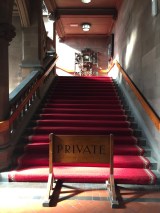
The first thing the rushed visitor finds when coming in the back passage is a PRIVATE sign: which hardly encourages you to go any further.  But the hardy, desperate visitor ignores these signs and heads up the stairs and eventually sees the signs they are wanting to see and heads off in that direction with one sole intent in mind.

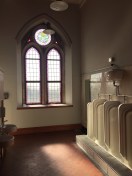
IMG_1500Once in the cloakroom (and the good burgers of Barrow have called it a cloakroom as opposed to resorting to a cruder nomenclature), the visitor can be delighted by the architecture and the efficiency of the water systems.
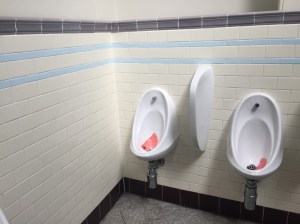
Relief is quick and efficient and on the way out, one gains a bit more understanding about Britain’s industrial past at the same time by being able to study and marvel at the history of UK submarine construction for which the town is rightly famous.

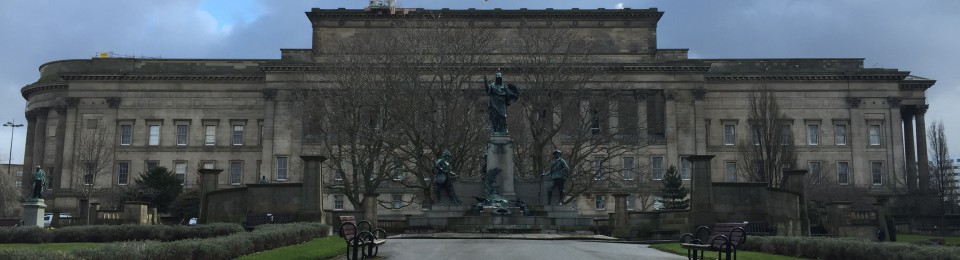
The Bog Standard Advisor: St George’s Hall, Liverpool.

An OfSTED inspector once confided in me: if you really want to know a school, go and visit its toilets. And she was not wrong: for all the froth and razzmatazz that a school could muster when government inspectors came to visit,there would be many times they would forget to look after the basics of their children’s needs. Teaching and learning strategies? Tick. Attendance records? Tick tick. Behaviour modification programmes? Oh yes, tick tick tick tick tick. But the school toilets?

2015-03-24 10.46.10In many a shiny school I visited, the toilets were still left in a disgraceful state. Cubicle doors kicked in, toilet paper hanging off the light bulbs and the stench of urine never far away and always beckoning you to look for the next urination hot spot.

Things were made worse by some bizarre school policies which instructed children not to go to the toilet at all between the hours of 9.30 and 10.17 precisely: or only on a Tuesday: or only if accompanied by a gazelle. No wonder the poor dear’s little bladders went into convulsion the moment they joined big school.

So since then I have been alert to the promise of shiny schools and the reality of their crap houses. And the same thing applies to many civic monuments up and down the country and around the globe: the magnificence of the Taj Mahal, the promise of liberation at The Statue of Liberty or the spiritual communing at The Vatican promise so much but deliver so little in the way of public amenities. It’s like they all want to celebrate the nobility of human endeavour without acknowledging that every King, President or Pope also needs a crap once in a while.

2015-03-24 10.47.01Happily, this is not the case with St George’s Hall in Liverpool. That it is a major public monument of historical significance is indisputable; that it offers a thousand and one ways for the occasional visitor to engage with the City’s past is without question: but the real icing on the cake are the gents toilets which are modestly upholstered and a welcoming relief to the bombast in the Big Hall along the corridor.

Decorated with some fetching light blue, grey and cream coloured tiles which make the urinals feel like a glorified beach hut as opposed to the nearest pharmacist’s clinic, the space enables you to go about your business with a spring in your step and song in your heart.

Liverpool may well have won the European City of Culture Award in 2008 and spent millions upon millions of pounds upon its local artists such as Royal De Luxe and their splendid puppets, but what will linger longer in the memory at a fraction of the price are the toilet facilities of St George’s Hall,  for those of you who have got caught short at Lime Street Station and can’t pay? won’t pay! the 30p the station will charge you.

The Bog Standard Advisor: Nottingham Town Hall.

IMG_1445Nottingham Town Hall is a highly salubrious venue when it comes to visiting the city’s glorious past and the many artefacts that reflect its long industrial history. It sits in the pride of place of Market Square and naturally attracts a lot of street vendors, mobile tea and coffee units and neighbouring restaurants.

What is less known about Nottingham Town Hall is that it is home to some very comfortable gentlemen’s toilets.

You can sit down in comfort, wash your hands at ease knowing full well that there is clean hand towel nearby and there are even baby changing facilities in the same room as the urinals.

IMG_1446Some might baulk at the idea of this kind of adjacency but there’s no getting away from it: if you’re half inclined to be taken short whilst you’re in the middle of Market Square in Nottingham, heading over to the Town Hall will provide you with quick, reliable and comfortable relief in a way that the local McDonalds Fast Food outlet will never be able to.


The Bog Standard Advisor: what’s it all about?

There are endless restaurant reviews across the world, reviewing every edible thing from eggs to echidna and back again.  One thing they all have in common is that they review and comment on the facilities which involve putting food and drink of various quantities and qualities into the human being.

What they frequently omit to mention are the facilities which involve disposing of the waste products that emerge once those food and drinkstuffs have been processed by aforesaid human being: namely, the toilet.  Or WC. Or Crapper. Or John. Or Bog. Or whatever you want to call it in your home town or metropolitan lair.

This bog-blog is going to address those deficiencies by irregularly reviewing toilets (WCs, crappers, johns etc.) that one has had the pleasure or displeasure to visit.  It will, without fear or favour, name the guilty and praise the innocents when it comes to advising the world’s public about which toilets (WCs, crappers, johns etc.) to use and which to avoid like the plague, just in case you stand a chance of catching nasty from the water system.

Watch this space… but don’t stand too close, just in case.

I am Peter? And I am? your workshop leader? For today?

Ok Peter, I get the message quickly that you are about to run this session today but what really perplexes me is your constant inability to talk in a straight line. You’ve developed that really annoying tendency Peter which turns a statement into a question by placing an upward intonation at the end of every sentence.

And worse still Peter, that high rising terminal is creeping into every part of your syntax so that after just a few minutes of your session, I’m left wondering whether you think I’ve never heard the name Peter before, whether you actually exist, whether you think I’ve ever heard of such a thing as a workshop leader and whether you’re suggesting you’re going to inflict your rising questions on me not just for today but possibly for tomorrow as well and heaven forbid for the foreseeable future.

It doesn’t instil confidence in me Peter that you know what you are doing and it doesn’t predispose me to liking you or engaging with the content you’re trying to impart. In fact Peter it makes me want to leave the room and go find someone else who knows his or her own name, knows what they’re doing and knows today’s date.

Just imagine Peter if you met a surgeon who introduced themselves like this: “I’m Doctor Smith? And I’m going to remove your appendix? later today?” What would you rate your chances Peter of getting on and off the operating table in the right number of pieces?

Or you’re on a plane about to take off and the pilot says, ‘Good morning ladies and gentlemen? We’re about to take off?” He may as well add, “if that’s all right by you?”.

See Peter, it just doesn’t instil confidence Peter in you as a human being or as a workshop leader. So please Peter, just cut out the questions and start speaking in straight lines again.

Francis Keith Aitken: A Life of Quiet and Steadfast Influence.

In February 1932 a young architect made a remarkable journey by boat and train from Khartoum, the capital of Sudan, up through Central and Eastern Europe to a large naval port, Stettin, in Pomerania, North Germany.

This journey was taken at a time prior to a period of extraordinary upheaval across the continent: the rise of National Socialism, the onset of the Second World War, the division of Europe, liberation 40 years on of Eastern Europe and the subsequent tragic conflict in the Balkans.

This architect who had, to his evident irritation and discomfort, just been made redundant by the Sudanese Government (on the orders of the British Government) travelled through places whose names and memories are inextricably linked with the tragedy and romance of our century – Constantinople, Belgrade, Budapest, Berlin.  He was armed solely with a pocket camera and passport, which he very nearly lost in Prague.

We should all give thanks to the young Czech train conductor who returned that passport and who allowed that memorable journey to continue. For what was the ultimate purpose of that journey? It was to meet and marry his fiancee, a young ‘Hortnerin’ in Stettin and so step out together on the longer and more demanding journey of a stable and happy marriage which lasted over 61 years.

The international spirit and steadfast nature of Keith and Lotti’s marriage has swept through our four generations of grandparent to great grandchild, in counterpoint to the political upheaval of the age,. And it has been Keith’s quiet and consistent ability of practising a benevolent internationalism which has created his extended family gathered here to day from across the world: from Germany, from Africa, from South America.

And it is this positive and unwavering influence that I would like us to thank him for: his influence which instilled a belief that the world belongs to all of us; that we would do well to tend and care for it; his tolerance which valued all cultures and beliefs and which accepted people as they are: and the proof that the meeting of a young architect from Cardiff with a young Hortnerin from Stettin can provide us all with a beacon of hope and aspiration.

In a world of change and chaos, you  have been constant and your love, quiet and steadfast. We thank you from all our hearts and from across the globe.

As Shakespeare said:

Our revels now are ended. These our actors,
As I foretold you, were all spirits and
Are melted into air, into thin air.
And, like the baseless fabric of this vision,
The cloud capp’d rtowers, the gorgeous palaces,
The solemn temples, the great globe itself
Yea, all which it inherit, shall dissolve
And, like this insubstantial pageant faded
Leave not a wrack behind. We are such stuff
As dreams are made on, and our little life
Is rounded in a sleep.

Testimonial for Francis Keith Aitken, August 1993

Dave Kinnear, Raconteur, Co-member of Everton Park and Bootle Sports Centre Squash Teams

A raconteur, according to my online dictionary, is someone who tells anecdotes in a skilful and amusing way.

Dave Kinnear was not a raconteur in the usual meaning of the word.

True, he would tell stories at great length – and who knows how many weird and wonderful stories he’s related over the years – and true he had a kind of storytelling skill – if converting a straightforward story into a complex mix of diversion, cul-de-sac and red herring is a skill, and true he would be amusing – albeit in a baffling kind of ‘Help, I’ve lost the plot, Dave!’ kind of way.

But more than all this, Dave was an urban myth, a legend in his own story life time – and the legends he is part of, are legendary.

Once, there was this fella who reckoned that he had been part of all his families stories – even though he hadn’t been born when they’d taken part. ‘I know these things!’ he’d say, mystically.

Once, there was this fella who persuaded his ill brother to let him drink his medicine – to stop this brother getting into trouble.

Once, there was this fella who had such a deft little wrist shot on the squash court – that his opponents would find themselves on court red faced, high tempered and fuming at the innocence of that squash shot which always had them running the wrong way, or left them flat footed or left them just looking plain silly.

We – his squash mates from Everton and Bootle – met Dave over 10 years ago at Everton Park squash courts – quite how, we can’t quite remember although Dave would have known…

We got playing together on Wednesday nights and before too long we had been signed up to the Thursday night league, complete with so called training on Sundays – again, quite why and how is fuzzy – but Dave would have remembered.

And before we knew it there we all were, driving around Merseyside over many cold winter Thursday nights to play at clubs we had difficulty finding in the squash league schedule – Burscough, Birkdale, Xaverien – pronounced for some reason that Dave would have explained – as SFX.

Dave, with his storytelling, anecdotes and explanations provided the social glue for our team.

Once, there was this fella who told stories in such complicated and detailed fashion, that his audience frequently turned to stone, complete with puzzled expressions across their stony brows.

But what his audience didn’t know was that Dave knew stories of before he was born, and consequently had so many stories to get out to his family and friends – and had so much to say – and so little time to say it – that he couldn’t be wasting time with the craft of telling his legends – so just got on with it, talking to everyone, conversing with everyone, remembering everyone and everything – and becoming a master raconteur to us all.

Dave, you’re a bit of an urban myth in our eyes – thanks for holding us together.

Nick Owen
Bootle EP Squash team
6 March 2006

What if Robin Williams met Anna Craft? What does losing 2 big C Creatives in a week tell us about us?

We’ve lost a couple of giants in the last week, both of whom speak of and for creativity albeit in very different ways: Anna Craft with her little ‘c’ creativity and Robin William’s big black dog of Creativity.

There can’t be many people out there who’ve not encountered Williams in his various disguises but probably a whole lot more who have never come across Anna’s work on creativity and learning. Whilst Williams’ creativity was bombastic, totalising and indisputable, Craft’s was more nuanced, subtle and ambiguous: with Williams you felt a target on the wrong side of the monologue but with Craft you did at least have a sense that you were in dialogue with her, previous generations and yourself.

Between them, they encapsulate the spectrum of difficulty of what it is to define, discuss or demonstrate that most infuriating of phenomena: the ‘c’ word. Is it all about individual genius which borders on insanity and can only be understood by defaulting to understandings of mental health, childhood trauma or drug fuelled psychosis? Or is it about more subtle ways of engaging with and imagining a world of possibilities? Or both?

Let’s do an Anna and ask ourselves, ‘What If they met on their own respective stairways to heaven? What might they have said to each other as they made their way through purgatory? And what insights might they generate as they waited to find out their future destiny? And where would that leave the rest of us?

Would Robin admit to a life long secret desire to be a nursery school teacher? And Anna to a thwarted ambition to entertain millions through her latent desire to be a rock guitar hero?  We’ll never know for certain of course: but one thing they could both agree upon is that without them gracing the earth for their short days, we would all be a lot poorer in understanding what it is to be human.

But if you do have an inside track on their conversation as they made it up into the stars, it would be great to hear about it!