Tips for Business Start Ups: why skills and knowledge are hugely overrated attributes in your potential workforce.

Alfie confided in me that the beauty of running a taxi business was that you didn’t need to know many things at all to make it succeed.

You didn’t need to be able to speak – many customers preferred you not to speak in fact; you didn’t need to be able to listen as your customers could either write down or text you their destination; you didn’t need to be able to add up as the meter did all the calculations and you certainly didn’t need to know where you were or where you were going as the Satnav would do that for you.

His next business challenge was to find a way of employing drivers who didn’t know how to drive or indeed recognise a motor vehicle in the first place.

He will find a rich vein of potential employees from the job centres or universities who will only too happily join his business and apply their lack of skills of driving and knowledge about taxis to great effect. They will join the growing band of aspirant Robert de Niro brothers who are only missing the obligatory Glock which would entitle them to call themselves fully paid up members of the taxi driving profession.

The notion that a complete absence of skill and knowledge in your workforce can benefit your business is a useful one which many other start up businesses – or even longstanding corporates – would do well to learn from.

Alfie has in fact recently left a telecoms giant where the inability to communicate with human beings was a real asset. His taxi business is clearly set to go far (just make sure you don’t get in one of his cabs if you want to make it home safely).

What kind of cheese is your organisation?

Organisations look pretty imposing from the outside: pictures of corporate serenity, coherent matching wall paper and carpet, an organism at one with itself and its surroundings. A well sorted business entity.

However, you’ll soon realise after working with organisations for a while, that this appearance of solidity and uniformity, is in actual fact a mirage and that all your average organisation actually is, is a large piece of cheese: smooth and daunting on the outside, but full of holes in the inside.

An organisations’ holes become apparent when messages get lost, staff don’t return calls, emails get unanswered and letters get returned to sender. Things fall down the cracks in the middle of departments, never to be seen again.

Apparently,, the cheese industry calls holes in cheese “eyes”. This is particularly ironic for those organisations whose infrastructure is so shot to pieces, they resemble slabs of Emmenthaler or Appenzell – the cheeses with the largest holes in them. If one thing a holey organisation doesn’t have, is eyes: or ears too for that matter.

And most times its digestive system doesn’t function properly either, from one end of the organisation to the other. the organisation which resembles a chunky piece of Emmenthaler tends to leak from both ends, often simultaneously.  You just have to look at the recent track record of the British Government to see a piece of Swiss Cheese in action and see integrity, intelligence, truth and vision draining away by the day.

Scientists say that the reason Swiss cheese is so holey is not due to hungry mice or over exuberant bacteria but due to the buckets being used when the milk is collected from the Swiss cow being contaminated with hay. Scientists are yet to establish why the UK government is leaking so profusely from all pores and both ends, but chances are it has very little to do with mice, bugs or hay.

Does your firm own your arse?

It’s holiday time again and stories abound of friends flying around with agendas of lands to be visited, food to be eaten and locals to be gawked at.

Except that in these days of austerity, zero hours contracts and presenteeist-induced guilt, friends the length of the land are foregoing their holidays for the sake of finishing the unfinished job, securing the unsecured contract and completing the as yet incomplete project.

 ‘Just stay at work for a few more days‘ their firms are urging them; or even, ‘take that laptop on holiday with you’ or better still ‘look, forget the holiday. Just stay put. What do you wanna go travelling for in any case? When you’ve got everything you need on our doorstep?’

Guilt-tripped  friends are now either moving their holidays, not taking them or just ignoring them for the sake of keeping their employer off their necks and to save their jobs and reputations.

If you’re in one of those firms that think it owns your arse, just remember the terms of your contract. Assuming you have one. Remember what trade unions fought long and hard for over the centuries. Assuming you belong to one.  And remember the only person who owns your arse is you and make sure you take it with you on that well overdue holiday, fearlessly.

Celebrate Easter and join Aspire’s virtual Hunt the Easter Elephant competition!

Yes, you heard it here first folks: instead of laboriously schlepping around the garden or your local park to hunt for pass-their-sell-by-date Easter Eggs, you can hunt for Easter goodies from the comfort of your own armchair, bathroom or bus queue – or wherever you read the Aspire Trust website from!

During Easter Sunday, we’ll be hiding 12 Easter Elephants through the many pages of the website (www.aspire-trust.org) – and if you can find all 12, just email info@aspire-trust.org with your name and email address and you could win a prize!

Everyone who identifies the location of all 12 Easter Elephants (ie the name of the webpages) will be put forward to a prize raffle which will be drawn at 12.00hrs GMT on Easter Monday: the winner will win 2 free tickets worth £50.00 to the opening keynote speeches at our All Our Futures conference on Monday 16 June (more details here).

So, if it’s pouring down on Easter Sunday and you’re worried how to break it to the kids that you won’t be spending any time soon foraging amongst the shrubbery for their Easter Eggs: then just log in here, look for the 12 Easter Elephants with your kids and family– and enjoy our site at the same time!

Like, snog, shag, marry, avoid? The relationship guide for would be business mentors.

Business mentoring has been getting a great press recently and for lots of good reasons: having a mentor is a great life choice for anyone in any stage of their life, not just when they’re in the process of starting up their business. But what does being a mentor actually entail? How can you become an effective one and ensure that your mentoring skills and knowledge are applied for their maximum effect?

Many mentors will tell you that the heart of a good mentor – mentee relationship is exactly that: it’s a relationship. It’s all about you and them. Simples, as the meerkat relationship managers might put it.

Well, yes, in one very important sense the process is based on a relationship between two people, rather than a person and a tree or a person and a pet budgie. On the other hand, just waving it away as merely a matter of ‘relationship’ as if that explained everything isn’t quite enough.

Assessing potential relationships along the ‘Like, snog, shag, marry, avoid?’ paradigm is one way of planning a mentoring relationship but opens itself up to all sorts of misunderstandings, walks of shame and life long regrets.

We might start by seeing the mentor – mentee relationship as a dialogue between two people whilst understanding that there are at least a further two people sat on the shoulders of each party whispering into the ear of that party. This ‘dialogue’ is really between four parents and their two children who are still wrestling out their own voice in the world.

We might also recognise that both the mentor and mentee (does anyone else squirm at that word, ‘mentee?”) exist in all kinds of contexts, the economic being just one. They are both rooted into complex soil systems of other relationships, networks, practices and habits: all these affect the ‘relationship’ between the two parties and need exploring to ensure a healthy relationship between the two of them.

And finally, we need to recognise that if a mentor mentee relationship has undercurrents of power surging under the surface – if the mentor is driven by the need to ‘do good’ or ‘help people’ for example – then there is a real risk that the ‘Like, snog, shag, marry, avoid?’ paradigm becomes the modus operandi of that relationship. And whilst that might be fun for a few star filled nights on far flung beaches, the hangovers of the morning after might not be what the business needs in the long term.

What is a SuperBusiness? 9 questions which will help shape the answer.

Spark Up in Liverpool makes much of creating 500 SuperBusinesses in 5 years across the Liverpool City Region. In a region whose business support services have generated many types of business and entrepreneurial activity, what is it that will make a SuperBusiness?

On one very straight forward level it has to mean starting up businesses which generate super levels of employment, turnover and profitability; businesses which can make a major contribution to the regional business economy. But being a SuperBusiness is much, much more than the bottom line metrics and measurable outputs.

SuperBusinesses will not merely operate in the Liverpool City region: they will have an acutely developed moral compass which which help shape it for the better: This means for the social and cultural ‘better’ as well as the economic ‘better’.

SuperBusinesses could shape either the region from hell – much like Tokyo in Bladerunners – or they could shape an en-nobled, ennobling, civilised and civilising space in which people’s entrepreneurial behaviour is directed towards the greater good. A region with 500 SuperBusinesses could either be filled with wide boys, hoods and spivs – or it could be like Venice. Or both. The choice is ours.

So what will tell us whether we’re seeing a SuperBusiness emerge in the next 5 years? And what might be the defining characteristics of those ventures? There will be several indicators which tell us whether we’re dealing with a SuperBusiness or just a bunch of charlatans out to make a fast buck and they’ll be seen in their responses to the following questions:

How are you engaging with the poor, excluded and disillusioned?
How are you giving air time and political influence to individual spirits?
How are you connecting nano-, micro- and mini- SMEs with the larger corporate players?
How are you recognising and responding to local culture – not just traditional, mainstream arts and museums but the myriad of ways in which people go about things and create value, difference and impact?
How are you valuing diversity and difference?
How are you not only tolerating dissent but appreciating it?
How are regulating yourselves and your public behaviours?
How are you valuing risk, challenge and uncertainty?
How are you engaging with the Japanese concept of wabi-sabi: a comprehensive Japanese world view or aesthetic centered on the acceptance of transience and imperfection. The aesthetic is sometimes described as one of beauty that is “imperfect, impermanent, and incomplete” (Wikipedia)

This is not just a job for the entrepreneurs and eager business men and women. If we want our SuperBusinesses to shape our city region we’re probably best starting at home. Our own businesses, whether super or not, could also begin to address those questions. If we want those SuperBusinesses to emerge from the gloom of the recent recession and spark up our region, we will all need to become at least a little bit ‘super’ in our own businesses for once in a while too.

For more information about Spark Up, please visit the website here.

Hanging out at the International Festival of Business: how is a business a school?

Contrary to what many employers might hanker after, potential employees do not arrive on their doorsteps for their first day of work as fully formed potential employees of the year. Employers might bemoan the lack of literacy, numeracy, ICT-cosy-ability, the ability to walk and talk at the same time and other human being related skills, but the proto-employee will have learnt loads of other things since they were in school, college, university or at Her Majesty’s Pleasure. Whether they were taught those things is another matter: but they will have certainly learnt loads of things albeit not necessarily of the employer-user-friendly-type.

That’s because as human beings our natural state of being is to learn, to be inquisitive, to be curious and to construct meaning. It’s what separates us from the dolphins, the chimps and the allegedly intelligent fungus that lives on leaf mould in Patagonia. None of these things construct meaning like human beings and if you’re not sure about that, just go to your nearest pub on a Friday after work and tell me what you see constructing meaning. Not a dolphin in sight and certainly no chimpanzee holding forth on why Manchester United are in such steep decline. No: it’s the human being in the room who is making meaning from their every day learnt experiences, many of which are forged in the workplace.

So, businesses might help themselves if they recognised that they have a stealth-like educational function to their raison d’être. This isn’t about passing exams or following curriculum or heaven forbid just learning a list of mechanical skills to evidence in their portfolio of competences: it’s much more important than that as it’s about making social sense of our existence, economic sense for our families and cultural sense for our communities.

Businesses may not think they’re schools but they so have a powerful educational mission and could do everyone a favour if they stepped up to the plate a lot more frequently.

More to follow on education and business at our June conference: http://www.allourfutures.co.uk

Hanging out at the International Festival of Business: how is a school a business?

Some time after the Tony Blair’s testosterone fuelled ‘education education education’ mantra started being chanted around UK school playgrounds, I found myself working with a number of schools around Liverpool who were preparing for the tsunami of funding that was heading their way.

Whether this was for kids from rich families or for kids from poor families who were starting with a deficit of life chances before they even stepped through the school gates or the kids in the middle who were neither GandT (Gifted and Talented, aka troubled, awkward and difficult to manage) nor HTR (Hard-to-Teach aka troubled, awkward and difficult to manage) but were still able to attract funding due to their perceived invisibility, the fact was that many schools found themselves awash with cash. Sometimes more than they knew what to do with and sometimes more than was good for them.

This led to many schools to take their fiduciary duties even more seriously and to believe that that they now had to start acting as if they were businesses.

This might involve the appointment of a ‘business manager‘ (sometimes a redeployed bursar who would have struggled in any commercial organisation, never mind one that was pretending to be one); the consideration of students as ‘customers‘ and the teeth grinding proposition that the curriculum was something that students could pick and choose from much like a visit to their favourite sweet shop on a Saturday afternoon.

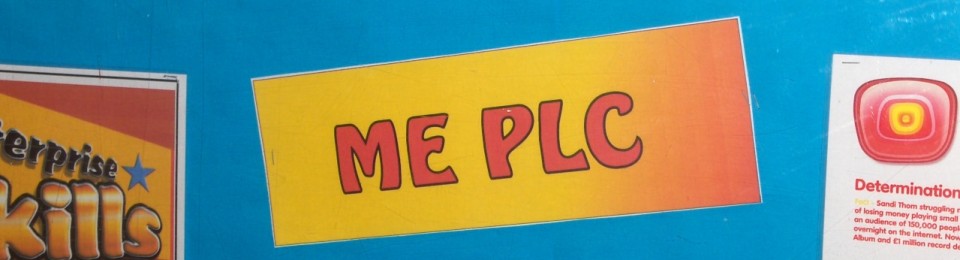
Now don’t get me wrong: I’m enthusiastic about personalising curriculum where it makes sense and responds to students’ interests in a meaningful and authentic manner: but all too often the personalisation agenda became subsumed within a Disneyfied agenda which threw any critical faculties off the fourth floor of the head teachers executive lounge suite and sold sold sold a morally bankrupted curriculum which valued the individual at all costs: visible in one school I visited which encouraged students to think of themselves as the Me PLC of their generation.

From now on, schools were businesses, students were customers and teaching subjects was something you only did in the privacy of your own home. ‘Subject knowledge’ became a dirty word used between consenting adults and certainly not something you would wax lyrical about in public.

There was of course a lot of resistance to this tendency of talking about schools as business centres; but more often than not, the rhetoric was seductive and many schools accepted their new identity as business start ups with the minimum of squealing.

What the consequences are of that turn of affairs will be explored in future posts – and of course at our next conference, All Our Futures which will be held in Liverpool in June 2014. Further details are here.

All Our Futures: The Business of Education or the Education of Business?

We’re producing our next All Our Futures international education conference in June this year and, as it’s part of the International Festival of Business (IFB) which is being promoted across the Liverpool City Region, we thought it only right and proper to align the focus of the conference with the energy of IFB itself.

Which is all very well until you start thinking about the thorny relationship between those two apparently innocent concepts: ‘business’ and ‘education’.

Surely (and here I’m reminded of Prof. Derek Colquhoun, my Ph.D supervisor’s comment that any sentence that starts with ‘surely’ should ring lots of alarm bells immediately) the links between education and business are obvious and trouble free?

Educating children is about preparing them to get work, create work and become valuable net contributing members of our economy isn’t it? Surely education must attend to the needs of business in order to make sure that our net contributing members of the economy (aka children) can take their fit and rightful place at the big dining table of the Big Society? Surely schools should remember that fundamentally they are businesses in their own right and grow up and behave as such?

Well, surely these ‘surelys’ are going to get a right good going over on this blog in the months to come and throughout All Our Futures too. I hope you can join us – either online or in person – because we surely are going to put the world to rights during that week!

For more information please visit http://www.allourfutures.co.uk