The awesome inflight navigator.

There is something awesome about the inflight navigator’s map which spells out the destinations you’re flying to, around, close by, towards, away from.

They appear pop up with a determination and sense that no argument is to be had here. Bucharest will follow Berlin which will follow Amsterdam. No questions to be asked and no debate to be entered or entertained.

They make you go I wanna go there, i wanna go there, what’s happening in Vladivostok this minute? Why is it so dark on the ground outside Addis Ababa? Where are those city lights of Singapore?

The inflight navigator is a tool of genius allowing us to put places in order, faces to places, histories to events and coherence where there was none before. Even if we’re 44,000 ft above sea level.

It speaks of places emerging out of the radar, beacons flashing in bizarre unnamed and unheard of places all for the benefit of the distanced traveller who kilometres above those ground installations  imagines mysteries, delights and conflicts both real and imagined. The beacon outside Yalta may be an insignificant piece of technical installation on the ground but in the sky it speaks of wars, hot and cold, of leaders,afraid and psychotic, of saunas both welcoming and poisoned.

Thank you, inflight navigator.

You speak of the sun moving across the earth. A huge U shape marks the spots the terrain where the sun is out and people dance sing wave their hands in the air and protest; and the terrain which is in the dark and where the people hide sleep and wander around in moments of anxiety fear and terror.

Some are in the light, others are in the dark. Many are on the cusp, either entering the dark times or anticipating the impending moments of light. Many others have no idea which direction they’re moving towards and fret accordingly.

You speak too of temperatures outside our cosy cabin. 20 degrees plus on the ground but soon dropping. 10. 5. Minus 5. Minus 20. Minus 50? Is that possible? Minus 79? Theres no such temperature where we come from but there is up here. Its a place for temperatures unbeknownst to many of us. It may as well be like living in Ethiopia for all the lack of familiarity it suggests. The Ethiopia down there has its counterpart up here. There’s no escaping the hostility of the planet.

Thank you, inflight navigator.

Pitch a Film on a Friday! A Beggarly Account of Empty Boxes: a 5 minute Romeo and Juliet with a cast of 1 and 2 dummies

It’s Brighton Pier, late Autumn. There’s an end of the pier show about to take place in the theatre, late on a Wednesday afternoon. It’s cold, desolate. Signs are banging in the wind, advertising…

“Father Larry presents…. Shakespeare as you’ve never seen before! Come wonder at the marvels of modern science!”

A lacklustre audience of end of the pier visitors drift out of the theatre and idly kick their heels around, waiting for the start of the main attraction – Father Larry.

A shifty looking Vicar – Father Larry – rushes up the pier, straightening up his dog collar, adjusting his trousers, wiping the lipstick off his collar and generally trying to tidy himself up and make himself respectable. He avoids the audience gathering by the front door of the theatre and squeezes himself through the stage door whilst no-one is looking.

He’s had a quick couple of scotches in the interval as a desparate attempt to continue the audience suspension of disbelief for the final 30 minutes of his show. He heads back stage to his dressing room, avoiding the stage hands and curses of the theatre manager.

Back stage, Father Larry’s dressing room. 2 large cane crates are placed in the centre of the room, with two large ventriloquist dummies left carelessly on top of them, limbs askew, clothing untidy. One’s a dummy of a young girl – Juliet – the other of a young boy – Romeo.

They both are trying to hold a conversation with other dummies which are stored away in the crates. It becomes clear they’re from two warring families – both are exhorted to return back to where they came from – their crates – by their families inside the crates and both agree that’s what they’ll do as soon as they’re physically able to do so.

They can’t stand the sight of each other as it happens anyway – they trade insults relentlessly and try to move their wooden bodies into a position where they could be taken back to the bosom of their families.

Father Larry crashes into the dressing room, swearing and sweating profusely. He’s been told that unless he sharpens his act up, he’s out of a job from the end of the afternoon. It’s been a disaster out there on stage and he’s got minutes to redeem himself and his act. His livelihood is nearly over.

He gets hold of the dummies angrily and tries manipulating them to talk to each other, to care for each other. They do as he says – although we sense their own individual dummy reluctance.

He acts out their family quarrels, disputes and expectations and urges them to love each other, much against their will. They comply but find subtle ways of resisting – falling of their crates, asking for a gottle of geer, that sort of thing.

He gets angry and bullies them into doing as he decides. He forces them into uncompromising sexual positions. They resist, he breaks them up, one by one, piece by piece. His act and livelihood are falling apart before his eyes.

When the pieces of the dummies have been flung across all corners of the dressing room, he realises what he has done. He’s distraught and tries putting them back together again, in vain. He tries to exert his religious influence on them, but to no avail. “A plague on both your houses!” he hisses at them. They both end up badly and violently damaged, strewn across the floor of the dressing room.

There’s a knock on the door. The second half of the show is about to begin. His time’s up. He has no option but to go on stage, empty handed. He tries playing out the role of the dummies himself but the audience see through him and drive him off stage.

He staggers woodenly down to the end of Brighton Pier, unable to shake off the dummy mannerisms that he’s adopted. His complexion has turned grey, his eyes – a mad staring look, his mouth – fixed in a permanent grin. “Good night, good night! parting is such sweet sorrow,” he mutters to himself. He stares out at the sea, tears rolling down his cheeks whilst still continuing to smile.

MenschMachine: Kraftwerk takes on the Medics and the NMR Industry

I’m led into a modest clinic, disinfected, spartan, imposing. A large nuclear magnetic resonance imaging device takes centre stage. The nurse tells me to lie down on a table, hold my arms in a fixed position, place my chin on a polystyrene pad and not to move. Apparently all my hydrogen ions are about to cajoled to spin in one direction – altogether now. The ones in my water molecules will spin at a different rate than the ones in my lipid molecules and they – the nurses, not the molecules – will be able to determine how healthy I am and whether I’ve spent to much time in the bar in recent years.

Slowly, the slab I’m on enters the machine and the chorus of clicks whirrs thuds hums and clanks kicks off. It’s like living in a Kraftwerk album, but in one of the lesser, in-progress tracks. But its not unpleasurable. Intriguing with a laser green light just a few inches above your head – and reminiscent of the Expo 2000 track they produced.

The clicks whirrs and thumps continue at regular intervals until the slab rolls back out of the machine. I’m told to turn over, tuck that in, loosen that and don’t forget to breathe. The process starts again for a further 10 minutes. This time you’re given head phones as the sound can reach upto 120 decibels apparently. “Something you might be familiar with,” smirks the nurse.

On the way out of the clinic you realise that you have just been examined by a Magnetom Magnetic Resonance Imaging machine which goes under the delightful name of the Symphony Maestro.

I don’t know why I’m surprised. The whole event has been a sub-orchestral event with some very low bass notes played in counterpoint to some ultra ultra high frequencies which only the local sewer rats can hear. It has been Kraftwerk at their most uninspiring. But fundamentally, this has been a musical event, not a medical one.

I realise I am used to Kraftwerk making all kinds of molecules vibrate in all kinds of ways in recent years. I reckon that the health information you could gather from listening to Tour de France for an hour would yield much better health benefits than the diagnostics the Symphony Maestro will be able to generate.

The event emphasises that the connections between arts and health – and in particular music – are closer than many nurses and doctors might like to admit to. Music is my first love warbled John Miles many years ago; this may be true but it might be more accurate to say that it is also our first way of connecting with the world through how its frequencies make our molecular structures resonate: although that would hardly be the title of a top ten hit, now, would it?

Continuing Education, Economic Growth and Changes of Mind and Culture

Life is what happens to you
while you’re busy
making other plans.

John Lennon, Beautiful Boy (Darling Boy)

This paper is about metamorphosis, and in particular the changes that occur during the process of transforming a publically sector driven education policy initiative into a third sector arts based education social enterprise. It will consider those changes that are forced upon the protagonists in that process; the changes the protagonists initiate for themselves and the effect of these changes on organisational structure, culture, identity, programme and the raison d’etre of the enterprise itself. It is particularly timely given the recent upheavals in the public sector and the Coalition government’s intention to broaden the supplier base of public services like to health and education to the private, charitable and social enterprise sectors.

It will do this by focusing on the Aspire Trust, a social enterprise based in Merseyside and will focus particularly on its current business activities in the field of continuous education and lifelong learning. Whilst it will demonstrate that its continuous education programmes have had a beneficial impact on its economic performance, the more significant findings and implications for practitioners who are considering the leap from public sector to social enterprise will be in relation to the structural, cultural and attitudinal changes took place during the company’s set up and establishment phases.

The changes that this company went through involved challenges on many practical and theoretical fronts: personal, social, political, artistic, and educational. Orthodoxies such as ‘The Business Plan’; ‘The Bottom Line’; ‘The Job’ all came under scrutiny in the company’s early years and the results of this scrutinisation are tangible in the company’s existence and will be drawn out through this blog.

The paper concludes with four specific transformations the company has undergone since its inception which have contributed to strengthening the linkage between its education programmes and its economic performance. These transformations are not however offered as a potential ‘toolkit’ for future social enterprise development but as the provisional and partial results of an retrospective analysis of the company’s birth and growth.

The paper will continue to develop here until its presentation at ISBE, Sheffield in November.

Poetry on the Hoof: Triangulated Data (v1.0)

Did he? Did she?
Does She?

Will he? Will she?
Would (will) She?

Did they? Would they? (if they did…)
Would She? (have…)

Maybe they did? Maybe they didn’t? (perhaps they couldn’t?)
Maybe She would maybe She wouldn’t (perhaps She couldn’t?)
But perhaps they did, perhaps they could have,
Perhaps She might, perhaps She would have,
Perhaps She dared where they feared
To tread
And perhaps they couldn’t.
When She would and could have
And perhaps they all just might have
Conspired, together, in cahoots
A perfect triangle
A seamless bubble
A little bit of surreptitiousness in the undergrowth.
Perhaps (they did) perhaps…

Pitch a film for Friday: TYTHING MAN!

TYTHING-MAN is a hardhitting, action packed political thriller set in Anglo Saxon Britain in 1098 AD.

We’re in a world we wouldn’t recognise as contemporary Britain or Europe: English society was organised around the Kingdoms of Mercia, Northumbria, Wessex, Kent, the Five Boroughs and East Anglia. Each Kingdom had its own King who had his own companions – The Earls and Landowners – who formed the basis of the nobility. Below them were the Ceorls – Farmers – and at the bottom of the pile were the serfs and peasants.

We’re in a time when the most significant technological advances were the horse collar, the tandem harness and the nailed horse shoe which did for the 11th century what steam did for the 19th and computerisation did for the 20th. This is a time when most people would hardly ever have seen a horse, and indeed, would have been terrifed of what a creature might represent.

This was a time of immense power and cultural shifts, with power shifting from being run on a Tribal to Feudal basis as the Norman Conquest of 1066 eventually took control of ‘England’.

But this was not a time of easy transition: tribal communities were breaking down, loyalties were changing from tribe to the state. Whilst paganism was reluctantly being replaced by Christianity it still had an active influence: Gods representing the days of the week: Tiw (a War God), Wodan (a Wizard), Thunor (God of Thunder) and Frig (Fertility Goddess) were all actively worshipped for the favours they could bestow upon their worshippers. Witches, giants, elves, dragons, sea monsters and nicors were all real forces and influences in people lives and had to be respected. Battling against these pagan forces was the Christian Church which, as well as offering moral and spiritual guidance, played an important part in the legal process: overseeing the plunging of an accused’s arm into a pan of boiling water, assessing the injuries later and then deciding on guilt or innocence on the basis of those injuries for instance.

Anglo Saxon Britain was not a place for the faint hearted.

This was a time when justice was rough, ready and directed by the community who had suffered at criminals hands. Communities would elect their own representatives – the Tything-Men – to secure peace and order for their communities. But like so much else of the era, judicial processes were also in a state of flux: ‘bottom up’ justice was giving way to ‘top down’ justice and the right to police the community was shifting away from the People to the State.

This is the time when the Tything Men secured order for the ordinary man and woman and jealously guarded their power and the film, TYTHING MAN, is their story of the struggle of progress and tradition, of community and state, of logic and superstition, of Religion and paganism, of the heart and mind.

Disneyworld as the aspirational role model for schools: just what’s so wrong with that?

Read on Twitter yesterday: Overheard a primary school learner describe a visit to a nearby high school as “this is like Disneyland”. It really was that good…

How tremendous would that be. School as an outpost of Disneyland and all its aspirational urgings: Let the memories begin…Explore the happiest place on earth…Welcome to the magic… all powerful metaphors which are hugely seductive for children, teachers and families.

And what’s so wrong with these metaphors? Why shouldn’t schools be the happiest places on earth? Perhaps there’s far too little magic in schools and a dose of Disneyfi-ed magic would do everyone a power of good? As a place to ‘let the memories begin’, its difficult to contradict the proposition that schools should be just that – places which shape memorable memories, shape our lives and futures and all that is good in the world.

And this is of course exactly the problem with the Disney model of school development and community building. There is no argument against it. It is impossible to critique the desire to be at the happiest place earth, the welcoming force of magic and a place for memory making. The Disneyfication of the school is the full stop at the end of the question which asks what schools are for.

Where is the place for resistance? For criticality? For unreconcilable difference? In short, no-where. There is no room for resistance in Disney. It is, as the Borg constantly remind us, futile. Any and all conflict in Disney is moderated, sanitised and overcome. The hero and heroine will always overcome the forces of the awkward buggers who get in their way. The awkward squad might be entertaining, or seductive in their repulsiveness: but one thing they never become are winners.

The individual- the Disney Hero – will always triumph in the Disney School: this is sometimes presented as being for the benefit of the individual themselves, at other times for the benefit of a wider, grateful community. Whatever else, the individual is central to all of Disney’s concerns. Nothing else matters as much as ensuring the desires of the individual are fulfilled. In that sense, the Disney school is the natural endpoint of the personalised learning agenda.

Which is where the combination of Disney and School in the same sentence becomes a potential nightmare because it generates the demand above all else that the child’s view is paramount. That their desires, interests, fashions and choices are all that matter; that the only function for teachers or other adults is to ensure their voices are heard and their demands met. In the Disneyfi-ed, personalised school, the child is in a 24/7 sweet shop, entranced by the baubles, hypnotised by the bangles, flattered by the flickering lights and fed, up to their back teeth, with the educational equivalents of coca cola, candy floss and Peter Pan.

But school is not a sweetshop. It should of course be magical and memorable and a place for happiness: but we should also welcome the reality that school is – and needs to be – tough, that learning is difficult, challenging and sometimes – dread word – boring. School – education – life – is a struggle, not a sherbet dip.

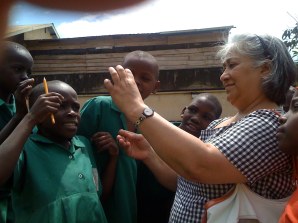
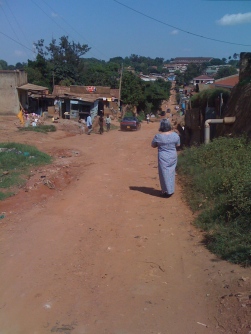
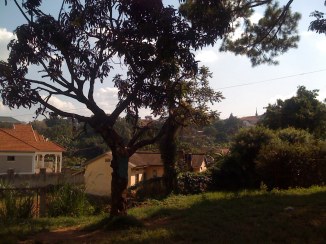
Uganda, day 3: searching for authenticity

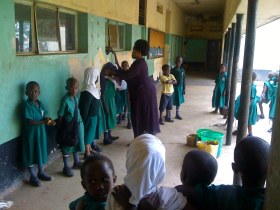
2008-06-11 13.06.14The endeavour in Kampala is very noticeable: seemingly chaotic but more a sense of heightened hustle and bustle without the tension which was in the streets and newspapers of Nairobi. White lines on the road from the airport was a good start, although the majority of them are pit-holed, roughened up and shot to pieces. You can see why you need an off roader here as the roads themselves are more off road than on road, what with the melted, rippled and solidified tarmac at their sides, the flaking away into the earth and the general chronic wear and tear.
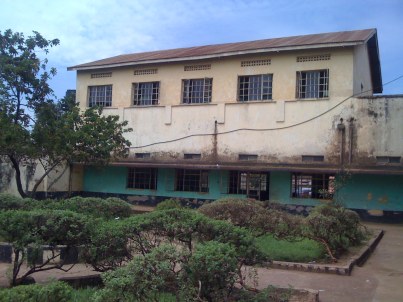
There ain’t nothing as authentic as your memories. We are looking for authentic matoke which has to be cooked properly (a la memory) and added to the right sauce. It’s comforting that the hotel is flanked by armed guards but talk on the TV of the Sudanese seeing the interventions of the LRA as an act of war is not so comforting. This will be a week of searching for authenticity and it might end in tears.

2008-06-11 12.36.57Day 4
The search for authenticity continues. Distances walked from home to school once seemed huge and never ending; when older they’re seen / they see us as short as from here to the next corner. The memory has been shrunk wrapped so that the journey is now no more than couple of blocks. Likewise, the house which at once seemed so large with innumerable rooms and possibilities is now no more than a modest shack in a compound with its crumbling walls and washed public spaces in which children play with meagre resources but ample imagination.

2008-06-11 15.15.48Day 5

It’s only memory that allows for spaces, possibility and heightened sensual experience. The revisit, the return, shrink wraps and diminishes. At best the terrors of the memory are perhaps lessened, made mundane and domesticated by the revisit and the horror can metamorphose into the ridiculous and the pathetic: at worst, the revisit causes the joys of the memory to be likewise sanitised, and recast into a new perspective which holds less import, moment or potential.

2008-06-11 15.54.50Day 6
We have spent many hours wandering in and out of I remembers and walking down memory lanes, putting bits of memory together. Confusion sets in once in a while when I remember those trees turns into those trees remember me and I’m left wondering whether spaces and places miss and yearn for us as much as we miss and yearn for them. Ironically, the search for authenticity when it gets close, results in a temporary emotional choking up, a temporary amnesia which means we forget more or less everything about that memory and the drive to authenticity that that memory induced.

And we speak of memory as if it is an intact entity, boundaried and discreet: perhaps a memory is more of a composite of senses, reflections, images, sounds, tastes and smells which coalesce occasionally to produce “a memory”.

2008-06-11 12.37.19Day 7
Capturing memory has been like trying to step into the same stretch of river twice. The river keeps flowing, nothing stays the same despite the appearance of the river bank, undergrowth and other assorted peripherania.

Things have flown away, the waters have traversed the ground carrying assorted flotsam and jetsam it collects, is donated or mysteriously acquires through some kind of adjacent leakage. The river keeps flowing, trying to capture and fix the memories is in vain, it’s all in vain…. as the children in the orphanage sang earlier this week.

2008-06-11 15.34.05

Everybody dance now! – revolutionary songs continue to drive the revolution through the rhetoric of crisis

The Arts in Schools: Principles, practice and provision was published by the Calouste Gulbenkian Foundation in 1982; it was followed some 17 years later by All Our Futures Creativity, Culture and Education, published by NACCCE, the National Advisory Committee on Creative and Cultural Education. Both documents can trace their heritage to Half Our Future, a report of the Central Advisory Council for Education (England) published in 1963 and chaired by John Newsom, which, in its turn pays homage to the work of Herbert Read and his 1957 conference report for the Joint Council for Education through Art, Humanity, Technology and Education.

In setting out their argument to reposition arts education (in 1982) and creativity and cultural education (in 1999) in the curriculum, the documents argue from the position that as we live in unprecedented times, with unprecedented challenges, it is essential that educational policy makers and practitioners look to a future which commits to the centrality of arts or creative education in the development of school cultures and curricula.

In the Gulbenkian report, these ‘unprecedented challenges’ revolve around patterns of employment, the relationship between education and society and the nature of cultural change in Britain. These changes are heightened by various ‘threats’ of ‘falling school rolls, cuts in public expenditure and some of the demands of educational accountability’ and are characterised in a language of despair: ‘actual provision for the arts in schools, so far from getting better, is facing serious deterioration’ ; ‘nationally, the situation is bleak and becoming bleaker’.

All Our Futures, published by NACCCE in 1999 and chaired by Ken Robinson, starts in a similar tone. ‘Education faces challenges that are without precedent which it repeats, (‘Education throughout the world faces unprecedented challenges: technological, social, and personal.’) and then elaborates upon: ‘the benefits of success are enormous and the costs of inaction profound’. From its first pages, the report argues that the need for creative education is predominantly economically driven:

In 1997, the Government published its White Paper Excellence in Schools. It described education as a vital investment in ‘human capital’ for the twenty-first century. It argued that one of the problems in education is the low expectations of young people’s abilities and that it is essential to raise morale, motivation and self esteem in schools. The main focus of the White Paper was on raising standards in literacy and numeracy. But this will not be enough to meet the challenges that face education, and the White Paper recognised this…. It emphasised the urgent need to unlock the potential of every young person and argued that Britain’s economic prosperity and social cohesion depend on this. This report argues that a national strategy for creative and cultural education is essential to that process.

Robinson has continued to communicate this message of unprecedented change in education and the link to economic well being. At a key note address to an international conference in Holland, for example, he expressed his view that the debates on creativity and the relationship of arts within the curriculum had a global significance: ’the truth is that every educational system represented at this conference, every education system everywhere, is facing a revolution.’

The quasi-apocalyptic views that Robinson has expressed over the last 25 years are not new and his is not the voice of the lone prophet in the wilderness. Robinson himself is an echo of earlier voices in the English education system broadcasting much the same message of the need to redress the place of arts education within the curriculum. For example, at the conference held by the Joint Council for Education through Art in 1957, Blackham concluded:

We believe that neither the contribution of the arts to general education, nor the place of general education in the national life has yet been properly recognised, and we want to form a body of enlightened opinion drawn from all walks of life which will bring general public opinion to share our conviction and see our vision of the role of the arts in general and the role of general education in the life of our industrial mass society.

The Gulbenkian report refered back to this conference, insisting that ‘It is all the more poignant… that this is a struggle in which we are now, even more pressingly, engaged 20 years on’. Now, a further 54 years on from that report, it is telling that variations on the same theme are being heard from arts educators not just within the UK but around the world.

As James Callaghan once (didn’t) say: Crisis, what crisis?

Extract from
When Herbert Met Ken: Understanding the 100 Languages of Creativity English in Education / National Association for the Teaching of English, Vol. 41 No. 2., 2007.
Available at
http://aspire-trust.academia.edu/NIckOwen/Papers/881601/When_Herbert_met_Ken_understanding_the_100_languages_of_creativity

Original references removed for the sake of brevity.

More at: https://drnicko.wordpress.com/2012/04/02/rejoice-a-little-known-connection-between-creativity-cultural-education-and-the-falklands-malvinas-campaign/