Bullseye! Look at what we could have won…

“That’ll kill you,” I cheerfully called out to the car parking attendant at the Covid-19 Vaccination Hub as he lit up a surreptitious cigarette on the side of the road. No doubt attuned to the futility of my off the cuff remark, he ignored me and kept his stare on the argumentative pair of security guards who were at it hammer and tongs down at the security gates.

“If you don’t like the fucking job why don’t you just fuck off?” remonstrated an elderly man heatedly to his younger colleague who was no slouch when it came to returning the insults. I missed the rest of the barbed comments between them as I turned the corner and entered the inner sanctum of the Hub: a long queue of hopefuls and sorrowfuls were stretched out in front of me, all waiting our turn for what we fervently hoped would be our promise of happier days ahead.

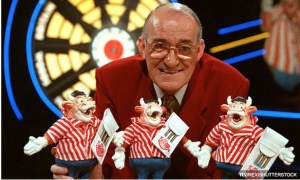
The inner sanctum had in a previous life been the hallowed ground of the Central TV studios where the ITV gameshow, Bullseye, was produced. Mixing general knowledge questions with darts, Bullseye was fronted by its once famous compère, Jim Bowen, who used to encourage his participants with several catchphrases: “Super Smashing Great” (although he disputed he ever said that); they’d receive their “BFH: Bus Fare Home” if they gambled but lost; “Keep out of the black and in the red; nothing in this game for two in a bed” referred to how contestants would have to avoid hitting the dart board in the same place twice; and perhaps the biggest killer catch phrase of all time, particularly in these Covid-sensitised times, “Look at what you could have won!”.

There was plenty of time to think about the irony of a site of a popular TV quiz game turning into a mass Vaccination Hub where the only prizes were of the Oxford / AstroZeneca or the Pfizer variety because the queue wended its way slowly into and around and through the studios.

There was no random throwing of darts into an outsize dartboard though; just the careful and attentive work of many NHS staff and volunteers, ensuring we were all focused on one common purpose: our salvation and wishes for better days for our friends, families, communities and nations after the disasters of 2020.

Look at what we could have won. You just had to read the news on your phone or in your newspaper to catch up with the recent mortality figures. 121,000 and still counting in the UK; unimaginable numbers across the planet.

But for all the solemnity and patience of the queue, the ability of the staff to react swiftly to an ever changing situation was remarkable: one young lad with diabetes was brought through the Hub at pace. He’d been struggling but his carers were dealing with it swiftly, directly and with the minimum of drama or game show pizazz.

It was one tiny insight into the myriad of struggles that people here, across the country, across the world, have been enduring over the last year. “Look at what you could have won!” I nearly called out to the car park attendant on my way out but thought better of it. He was enjoying his cigarette in the warm early Spring afternoon air and didn’t need any more reminders of what is just around the corner.
Confessions of an Ageing Tennis Player: it’s your go!

Hi Y’all!

Hope you’re keeping well in these very difficult times! In the next few weeks of the Tennis Player campaign, I’m offering you the opportunity to become the tennis player you always wanted to be!

Just imagine you’ve become your favourite tennis player, write me a short blog about you as whoever it is, and I’ll post it along with the promotional video! It can be as long or as short as you like!

And if you fancy reading the script of the promotional video, just email me at richardnyowen@msn.com and I’ll help you sort it out.

Keep safe!

Confessions of an Ageing Football Player: out tomorrow!

Rust, dust and lust: a cautionary tale of resilience.

Once upon a time there was a castle which was crumbling from the foundations upwards. The white ants had been busy over the years and whilst the facade looked stable, the foundations had powdered to ashes and the ashes had powdered to dust and the dust had blown away in the cruel winds of fortune.  One day, with the townsfolk looking on and attending a gigantic carnival in the middle of the splendiferous grounds, the castle, once so proud and austere, so demanding of its audiences and towns folk, decided to call it a day and crumbled away to very little in the space of a couple of shocking seconds.

Gasps wouldn’t do justice to the sounds the townsfolk made when they saw their castle disappear in front of their eyes.  Something that had appeared so steady and so reliable had been shaken to nothing in the blink of several thousands’ peoples’ eyes.

To be continued…

Stories on Whall’s: King Arthur’s Hall, Tintagel, Cornwall.

King Arthur’s Great Hall was built in the 1930s by a custard millionaire whose company is thought to have invented the confection “hundreds and thousands”. The Halls of Chivalry are built from 53 different types of stone and are big enough to hold 1000 people. Whall designed 72 stained glass windows which tell the story of King Arthur and show the Coats of Arms and weapons of the knights involved. (List of works by Veronica Whall)

Stories on Whalls: St. Marys Church, Bleasby, Nottinghamshire

St Mary’s Church, Bleasby. Nottinghamshire 1910,  known as the “Magnificat” window and the easternmost window in the south wall of the nave, this window is a memorial to Henry Lewis Williams, who was the vicar at St Mary’s for twenty-two years, from 1888 to 1910. It has three lights with St Mary with the child Jesus in the central light. The two side lights feature angels playing musical instruments. The principal inscription on the window is the opening words of the Magnificat: “My soul doth magnify The Lord and my spirit rejoices in God my saviour”. In the bottom right hand corner an inscription reads: “To the Glory of God, and in loving memory of Henry, Lewis Williams: for twenty-two years Vicar of this parish 1888–1910”. (List of works by Christopher Whall)

There is something mournful about seeing a solitary maypole in a field outside a church. Despite the cheerful “Welcome to Glebe Field” sign on the gate which leads to it,  the solitary maypole spoke of pleasures long since past whilst it resolutely stood upright in a small bit of pasture which seemed not to mean much to anyone.

They’re called orphan spaces in some parts of the world: not large enough to be anything particular and usually un-noticed and unloved, even though they may be used for a variety of purposes like walking the dog (although not here), fireworks, bonfires and camping (although also not here).

The Nottingham arts production company, Excavate, for example, work on how to create interventions in spaces which draw attention to the histories and identity of orphan places, amongst others. They use the atmospheres and challenges of spaces to interrogate their value and potential future use; and find ways to create spaces in those places where people feel able to sit and talk and share ideas and stories.

Whilst St. Mary’s Church hasn’t orphaned its Whall windows,  the maypole in the field next door is looking a bit unloved. Perhaps one day the church will be able to extend the hand of friendship to the field and bring the orphan space, complete with maypole, back into the fold.

Stories on Whalls: All Saints Church, Little Casterton, Rutland.


“The East and West windows are by Whall and are in memory of former tenants of Tolethorpe Hall. The east window depicts St Hubert, “Christ in Majesty” and St Francis and is in memory of Hubert Francis Christian Harrisson. The west window features St George and dates to 1919. According to legend, St Hubert was an eighth-century nobleman who was converted to a religious life by the vision of a stag bearing a crucifix between its antlers, seen when hunting in an Ardennes forest on a Good Friday.”  (List of works by Christopher Whall)

Psalm 22: King James Version (KJV)

1 My God, my God, why hast thou forsaken me? why art thou so far from helping me, and from the words of my roaring?
2 O my God, I cry in the day time, but thou hearest not; and in the night season, and am not silent.
3 But thou art holy, O thou that inhabitest the praises of Israel.
4 Our fathers trusted in thee: they trusted, and thou didst deliver them.
5 They cried unto thee, and were delivered: they trusted in thee, and were not confounded.
6 But I am a worm, and no man; a reproach of men, and despised of the people.
7 All they that see me laugh me to scorn: they shoot out the lip, they shake the head, saying,
8 He trusted on the Lord that he would deliver him: let him deliver him, seeing he delighted in him.
9 But thou art he that took me out of the womb: thou didst make me hope when I was upon my mother’s breasts.
10 I was cast upon thee from the womb: thou art my God from my mother’s belly.
11 Be not far from me; for trouble is near; for there is none to help.
12 Many bulls have compassed me: strong bulls of Bashan have beset me round.
13 They gaped upon me with their mouths, as a ravening and a roaring lion.
14 I am poured out like water, and all my bones are out of joint: my heart is like wax; it is melted in the midst of my bowels.
15 My strength is dried up like a potsherd; and my tongue cleaveth to my jaws; and thou hast brought me into the dust of death.
16 For dogs have compassed me: the assembly of the wicked have inclosed me: they pierced my hands and my feet.
17 I may tell all my bones: they look and stare upon me.
18 They part my garments among them, and cast lots upon my vesture.
19 But be not thou far from me, O Lord: O my strength, haste thee to help me.
20 Deliver my soul from the sword; my darling from the power of the dog.
21 Save me from the lion’s mouth: for thou hast heard me from the horns of the unicorns.
22 I will declare thy name unto my brethren: in the midst of the congregation will I praise thee.
23 Ye that fear the Lord, praise him; all ye the seed of Jacob, glorify him; and fear him, all ye the seed of Israel.
24 For he hath not despised nor abhorred the affliction of the afflicted; neither hath he hid his face from him; but when he cried unto him, he heard.
25 My praise shall be of thee in the great congregation: I will pay my vows before them that fear him.
26 The meek shall eat and be satisfied: they shall praise the Lord that seek him: your heart shall live for ever.
27 All the ends of the world shall remember and turn unto the Lord: and all the kindreds of the nations shall worship before thee.
28 For the kingdom is the Lord’s: and he is the governor among the nations.
29 All they that be fat upon earth shall eat and worship: all they that go down to the dust shall bow before him: and none can keep alive his own soul.
30 A seed shall serve him; it shall be accounted to the Lord for a generation.
31 They shall come, and shall declare his righteousness unto a people that shall be born, –that he hath done this.

If a shorter text is preferred, use 1 – 11 or 1 -20.

Thank goodness for the shorter text. Whilst the King James Version bible has a certain commanding theological gravitas,  the people who translated it appreciated brevity over gravity, and understood that the average congregation member may be unfamiliar with the strong bulls of Bashan (v12), and may not have much time to find out about them either. Such is church life it seems these days. Huge texts to communicate and illuminate and such little time to do it in.

Up the road at Tolethorpe Hall, they have a similar issue to contend with: huge Shakespeare texts to perform in a venue which is susceptible to the weather and liable to curtail their expressive tendencies at the drop of a Easter snowflake.

It was comforting to note that Christopher Whall’s work in the church was made in memory of the former tenant of Tolethorpe Hall – which in turn has memorised his work by installing their own stained glass windows in their splendid building.

Whether Tolethorpe Hall will produce a full rendition of Shakespeare’s Hamlet – all 30,557 words of it – is probably as likely as the church congregation singing the full 31 verses of Psalm 22 – but they are both tasks worth stepping up to the dramaturgical ecclesiastical plate for. Even if the potential audience is likely to doze off after a short while.

Stories on Whalls: St. Mary’s Church, Stamford, Lincs.


Whall designed the Lady Chapel East window in 1891. This was Whall’s first independent commission and was given to him by John Dando Sedding. Whall described the window as “the foundation and beginning of everything”. Indeed Whall designed and made the window, with the help of one assistant, in a cowshed at Stonebridge, near Dorking in Surrey which Whall was using as a workshop. Meticulous preparation was said to have gone into producing the window, including the making of a suit of armour for the St Michael figure from papier-mâché – which his assistant had to wear! The window shows Adam and Eve in the outer main lights flanking Gabriel and St Michael with the Virgin & Child in the centre light. The tracery lights are based on the Mysteries of the Rosary. At the apex of the tracery is the Coronation of the Virgin. The firing and glazing were carried out by Britten & Gilson. The image in gallery below is shown courtesy Peter Jones. In The Buildings of England: Lincolnshire by Nikolaus Pevsner and John Harris they say of this window “in a style derived from the Pre-Raphaelites but more hard edged and Impressionist”. There is a second window dating to 1893 in the North side of the Lady Chapel this completed jointly with Louis Davis. (List of works by Christopher Whall)

“Listen, God love everything you love – and a mess of stuff you don’t. But more than anything. God loves admiration.”
You saying God vain? I ast.
Naw, she say. Not vain, just wanting to share a good thing. I think it pisses God off if you walk by the colour purple in a field somewhere and don’t notice it.”  (Alice Walker, The Color Purple)

(Thanks to John Smith for all his help and insight on the Christopher Whall window.)

Stories on Whalls: Trinity House, Leicester.

These almshouses were founded in 1331 by Henry Earl of Lancaster and Leicester and were rebuilt in 1901. The original almshouses were known as the “Hospital of Annunciation of the Virgin Mary”. They were for a warden, 4 chaplains and 50 poor and infirm people, 20 of whom were to be resident there. By 1354 the number of resident poor people had doubled to 40. The almshouse survived the dissolution and was renamed Trinity hospital in 1614. Whall executed an East window for the Chapel. (List of works by Christopher Whall)

You never know who’s looking over your shoulder.

“The Vice-Chancellor and his senior staff are delighted that you are able to join them for lunch. The lunch will take place after the ceremony in Trinity House at 12.00 for 12.20pm.”
So I sit down amongst the finery and refinery sporting my guest badge meeting with a laudable gent from the Guild of Patten Makers (inserts in shoes not templates for sheet metal) and a lecturer in photography and before you know it there’s a very decent three course meal and then someone gives a welcome speech and then I’m chatting to someone from the arts and humanities department about the cross overs between arts and science education and evaluation processes and what’s causal and what isn’t then someone points to the bread and something in a bowl next to it and we’re not sure whether it’s pate or butter and then there’s a very nice glass of wine on offer but I’m not drinking as it’s midweek and if I have a glass now I shall be out like a light and then there’s some very appetising chicken so I give the wine a miss but the elderflower cordial is pretty lovely and think I’d better get off to work as it’s a busy day and I have a meeting in thirty minutes and then I have a train to catch and then there’s loads to do and it’s fifteen minutes until the next meeting and then and then and then and then.

What I didn’t do was stop in my tracks. Turn a corner and look up at the altar at the end of the chapel. If I had, I would have seen the magnificent window by Christopher Whall, benignly staring at us assembled hoards, albeit around the corner, just feet from where I was sitting.

I didn’t have a clue who or what was looking down as this whole stained glass window thing was news to me and anyway I was far to busy to stop in my tracks this time but I should have stopped I should have done and taken it in for a few minutes how something in our past can be just around the corner out of sight but benignly present if we were so inclined to see it.

We don’t stop often enough to take stock of what’s just around the corner, wishing us all good grace and offering to be an angel in the midst of our day. And we lose out, being engulfed in the mist of our daily routines.