Bullseye! Look at what we could have won…

“That’ll kill you,” I cheerfully called out to the car parking attendant at the Covid-19 Vaccination Hub as he lit up a surreptitious cigarette on the side of the road. No doubt attuned to the futility of my off the cuff remark, he ignored me and kept his stare on the argumentative pair of security guards who were at it hammer and tongs down at the security gates.

“If you don’t like the fucking job why don’t you just fuck off?” remonstrated an elderly man heatedly to his younger colleague who was no slouch when it came to returning the insults. I missed the rest of the barbed comments between them as I turned the corner and entered the inner sanctum of the Hub: a long queue of hopefuls and sorrowfuls were stretched out in front of me, all waiting our turn for what we fervently hoped would be our promise of happier days ahead.

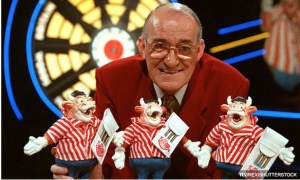
The inner sanctum had in a previous life been the hallowed ground of the Central TV studios where the ITV gameshow, Bullseye, was produced. Mixing general knowledge questions with darts, Bullseye was fronted by its once famous compère, Jim Bowen, who used to encourage his participants with several catchphrases: “Super Smashing Great” (although he disputed he ever said that); they’d receive their “BFH: Bus Fare Home” if they gambled but lost; “Keep out of the black and in the red; nothing in this game for two in a bed” referred to how contestants would have to avoid hitting the dart board in the same place twice; and perhaps the biggest killer catch phrase of all time, particularly in these Covid-sensitised times, “Look at what you could have won!”.

There was plenty of time to think about the irony of a site of a popular TV quiz game turning into a mass Vaccination Hub where the only prizes were of the Oxford / AstroZeneca or the Pfizer variety because the queue wended its way slowly into and around and through the studios.

There was no random throwing of darts into an outsize dartboard though; just the careful and attentive work of many NHS staff and volunteers, ensuring we were all focused on one common purpose: our salvation and wishes for better days for our friends, families, communities and nations after the disasters of 2020.

Look at what we could have won. You just had to read the news on your phone or in your newspaper to catch up with the recent mortality figures. 121,000 and still counting in the UK; unimaginable numbers across the planet.

But for all the solemnity and patience of the queue, the ability of the staff to react swiftly to an ever changing situation was remarkable: one young lad with diabetes was brought through the Hub at pace. He’d been struggling but his carers were dealing with it swiftly, directly and with the minimum of drama or game show pizazz.

It was one tiny insight into the myriad of struggles that people here, across the country, across the world, have been enduring over the last year. “Look at what you could have won!” I nearly called out to the car park attendant on my way out but thought better of it. He was enjoying his cigarette in the warm early Spring afternoon air and didn’t need any more reminders of what is just around the corner.
Rust, dust and lust: a cautionary tale of resilience.

Once upon a time there was a castle which was crumbling from the foundations upwards. The white ants had been busy over the years and whilst the facade looked stable, the foundations had powdered to ashes and the ashes had powdered to dust and the dust had blown away in the cruel winds of fortune.  One day, with the townsfolk looking on and attending a gigantic carnival in the middle of the splendiferous grounds, the castle, once so proud and austere, so demanding of its audiences and towns folk, decided to call it a day and crumbled away to very little in the space of a couple of shocking seconds.

Gasps wouldn’t do justice to the sounds the townsfolk made when they saw their castle disappear in front of their eyes.  Something that had appeared so steady and so reliable had been shaken to nothing in the blink of several thousands’ peoples’ eyes.

To be continued…

MenschMachine: Kraftwerk takes on the Medics and the NMR Industry

I’m led into a modest clinic, disinfected, spartan, imposing. A large nuclear magnetic resonance imaging device takes centre stage. I am told to lie down on a table , hold my arms in a fixed position, place my chin on a poystyrene pad and not to move. Apparently all my hydrogen ions are about to cajoled to spin in one direction – altogether now. The ones in my water molecules will spin at a different rate than the ones in my lipid molecules and they – the nurses, not the molecules – will be able to determine how healthy I am and whether I’ve spent to much time in the bar in recent years.

Slowly, the slab I’m on enters the machine and the chorus of clicks whirrs thuds hums and clanks kicks off. It’s like living in a Kraftwerk album, but in one of the lesser, in progress tracks. But its not unpleasurable. Intriguing with a laser green light just a few inches above your head and reminiscent of the Expo 2000 track they produced.

The clicks whirrs and thumps continue at regular intervals until the slab rolls back out of the machine. I’m told to turn over, tuck that in, loosen that and don’t forget to breathe. The process starts again for a further 10 minutes. This time you’re given head phones as the sound can reach upto 120 decibels apparently. Something you might be familiar with smirks the nurse.

On the way out of the clinic you realise that you have just been examined by a Magnetom Magnetic Resonance Imaging machine which goes under the delightful name of the Symphony Maestro.

I don’t know why I’m surprised. The whole event has been a sub-orchestral event with some very low bass notes played in counterpoint to some ultra ultra high frequencies which only the local sewer rats can hear. It has been Kraftwerk at their most uninspiring. But fundamentally, this has been a musical event, not a medical one.

I realise I am used to Kraftwerk making all kinds of molecules vibrate in all kinds of ways in recent years and reckon that the health information you could gather from listening to Tour de France for an hour would yield much better health benefits than the diagnostics the Symphony Maestro will be able to generate.

The event emphasises that the connections between arts and health – and in particular music – are closer than many nurses and doctors might like to admit to. Music is my first love warbled John Miles many years ago; this may be true but it might be more accurate to say that it is also our first way of connecting with the world through how its frequencies make our molecular structures resonate: although that would hardly be the title of a top ten hit, now, would it?